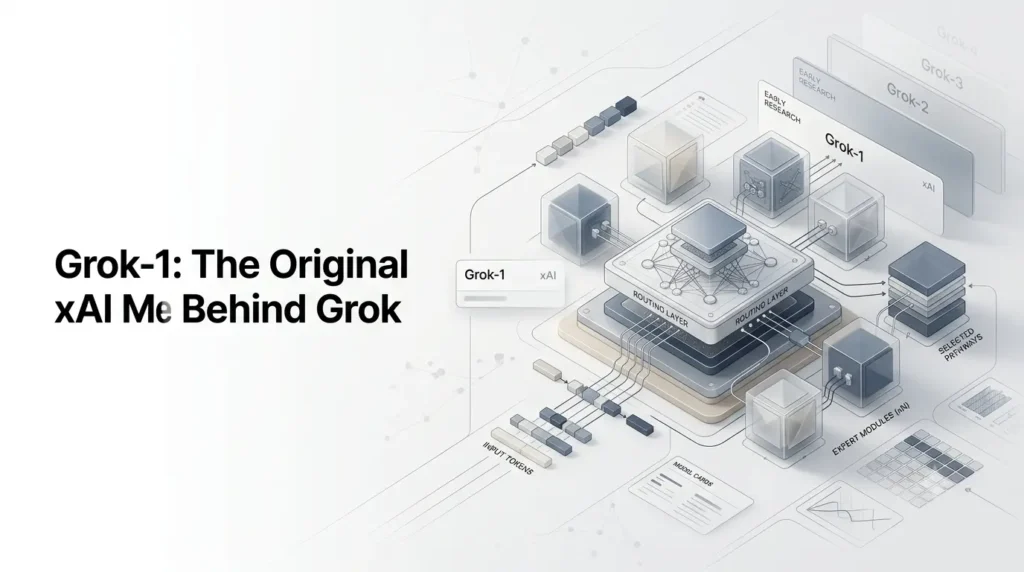
Grok-1 was the original large language model developed by xAI and the model that powered the first version of the Grok AI assistant. Announced in November 2023, it introduced xAI’s approach to conversational AI, combining language generation, reasoning and coding capabilities with access to real-time information through the X platform when deployed as Grok.
Grok-1 was also unusual because xAI later released its model weights and architecture publicly. The open release revealed a 314-billion-parameter Mixture-of-Experts (MoE) architecture under the Apache 2.0 license, giving researchers and developers an opportunity to study and experiment with the model.
Although Grok has since progressed through Grok-1.5, Grok-2, Grok-3 and later generations, understanding Grok-1 provides useful context for how xAI’s model family evolved.
Quick Summary
- Grok-1 was xAI’s original major language model and the foundation of the Grok AI family.
- It was introduced in November 2023 and initially had an 8,192-token context window.
- The open-weight model has 314 billion parameters and uses a Mixture-of-Experts (MoE) architecture.
- Grok-1 supported question answering, writing, coding, information retrieval, and reasoning tasks.
- xAI released its weights and architecture under the Apache 2.0 license in March 2024.
- The released model was a base pretrained model, not the complete conversational Grok assistant.
- Grok-1.5 later expanded the context window to 128K tokens, while Grok-1.5V introduced multimodal capabilities.
- Today, Grok-1 is mainly important for AI research, experimentation, and understanding the evolution of xAI’s Grok models.
What Is Grok-1?
Grok-1 was xAI’s first major large language model and the underlying engine of the original Grok assistant.
The model was an autoregressive Transformer-based language model trained for next-token prediction and subsequently fine-tuned using feedback from humans and earlier Grok-0 models. xAI’s original model card lists an 8,192-token context length for the initial Grok-1 release in November 2023.
The model was designed for tasks including:
- Question answering
- Information retrieval
- Creative writing
- Coding assistance
- General language understanding
- Reasoning-related tasks
However, there is an important distinction between Grok-1 as a language model and Grok as the consumer assistant.
The original Grok product could use external information sources, including the X platform, while the underlying Grok-1 model itself did not independently search the web. xAI explicitly noted this distinction in its model card.
When Was Grok-1 Released?
The history of Grok-1 is closely connected to the launch of xAI.
xAI announced the company in July 2023 and subsequently developed its first prototype, Grok-0. According to xAI, Grok-0 had 33 billion parameters and was developed as an early prototype during the company’s initial research period.
The progression was roughly:
| Stage | Date | Significance |
|---|---|---|
| xAI announced | July 2023 | xAI introduced its new AI research company |
| Grok-0 | 2023 | Early 33B-parameter prototype |
| Grok-1 announced | November 3, 2023 | First major Grok model and assistant |
| Grok on X | November–December 2023 | Initial consumer rollout |
| Grok-1 open release | March 17, 2024 | 314B model weights and architecture released |
| Grok-1.5 | March 28, 2024 | Major improvement with much longer context |
| Grok-1.5V | April 12, 2024 | First multimodal Grok model |
xAI’s company timeline lists Grok-0 in August 2023, the original Grok announcement in November 2023, Grok’s arrival on X in December 2023, and the later Grok-1.5 releases in 2024.
How Did Grok-1 Start the Grok AI Family?
Grok-1 established several themes that continued into later generations.
The original announcement described Grok as an AI designed to answer questions with a degree of wit and a distinctive personality. More importantly from a technical perspective, xAI positioned the system around research assistance, knowledge retrieval, reasoning and coding.
Grok-1 therefore served as the foundation for the broader Grok product rather than simply being another standalone chatbot model.
Its development established the basic progression that followed:
Grok-0 → Grok-1 → Grok-1.5 → Grok-1.5V → Grok-2 → Grok-3 → later Grok generations
Each subsequent generation expanded the capabilities and scale of the system.
What Were the Main Features of Grok-1?
1. Natural Language Understanding
Grok-1 was designed to understand and generate natural language, allowing it to handle conversational questions, explanations, writing tasks and information-oriented requests.
The model card specifically lists question answering, information retrieval and creative writing among its intended uses.
2. Coding Assistance
Coding was another important part of Grok-1’s initial capability set.
In xAI’s original announcement, the company reported a 63.2% score on HumanEval, a coding benchmark, for Grok-1. xAI also reported a 73% score on MMLU, a broad academic and knowledge benchmark.
These figures are historical benchmark results from xAI’s 2023 evaluation and should not be interpreted as measurements of the performance of current Grok models.
3. Reasoning
xAI said that it made significant improvements in reasoning and coding during the development period leading from Grok-0 to Grok-1.
The company evaluated Grok-1 on reasoning benchmarks and curated mathematics examination questions. It also used early testers and adversarial testing as part of its evaluation process.
4. Real-Time Information Through Grok
One of the features that distinguished the original Grok experience was its relationship with the X platform.
xAI described real-time knowledge of the world through the X platform as a fundamental advantage of Grok. This was part of the Grok product experience, rather than a capability of the raw Grok-1 language model itself.
That distinction is important when reading older descriptions of Grok-1.
What Was the Grok-1 Architecture?
The Grok-1 open release provided substantially more technical information than the initial consumer announcement.
xAI released Grok-1 as a 314-billion-parameter Mixture-of-Experts model. The model uses eight experts, with two experts selected for each token according to the published architecture. It contains 64 layers and uses a maximum sequence length of 8,192 tokens.
Key published specifications include:
| Specification | Grok-1 |
|---|---|
| Parameters | 314 billion |
| Architecture | Mixture of Experts |
| Number of experts | 8 |
| Experts used per token | 2 |
| Layers | 64 |
| Query attention heads | 48 |
| Key/value heads | 8 |
| Embedding size | 6,144 |
| Maximum sequence length | 8,192 tokens |
| Tokenizer | SentencePiece |
| Tokenizer vocabulary | 131,072 tokens |
| RoPE | Supported |
| 8-bit quantization | Supported |
These specifications refer to the open-weight Grok-1 model published by xAI.
What Does 314 Billion Parameters Mean?
A parameter is a numerical value learned during model training. Large language models contain billions or even hundreds of billions of these values.
Grok-1’s 314-billion-parameter figure describes the size of the published model architecture. However, because Grok-1 uses a Mixture-of-Experts design, not every expert is used for every token.
xAI’s open-release announcement states that approximately 25% of the weights are active for a given token.
This is one reason simply comparing parameter counts between different architectures can be misleading.
Was Grok-1 Open Source?
Grok-1 was released with its model weights and architecture under the Apache 2.0 license.
However, there is an important terminology distinction.
xAI described the March 2024 release as an open release of the weights and architecture. The company did not release the entire original training process or training dataset. The published checkpoint was also a base model, not a dialogue-optimized version of Grok.
The official repository provides JAX code for loading and running the model and documents its architecture.
So calling Grok-1 simply an “open-source chatbot” would be inaccurate. A better description is an open-weight base language model released under Apache 2.0.
Can You Run Grok-1 Locally?
Technically, yes, but Grok-1 is extremely large.
The official repository states that the model contains 314 billion parameters and requires substantial GPU memory to run. The repository provides instructions for downloading the checkpoint and running the model with its example implementation.
This makes Grok-1 very different from the relatively small language models commonly run on consumer hardware.
Running the full model requires substantial computational infrastructure, particularly when using the original model representation. The official implementation was primarily provided as a way to validate and experiment with the released model rather than as a lightweight desktop chatbot package.
For most users, therefore, Grok-1 is more relevant as a research and historical open-weight model than as a practical local AI assistant.
What Were the Limitations of Grok-1?
Grok-1 was an early-generation model, and xAI’s own documentation identifies several limitations.
1. Limited Context Length
The initial Grok-1 model had an 8,192-token context length.
That was considerably smaller than the context windows introduced by later Grok models.
2. No Independent Web Search
The underlying Grok-1 language model did not independently search the web.
xAI explained that external search tools and databases could improve factuality when Grok was deployed with those capabilities.
3. Hallucinations
Like other language models, Grok-1 could generate incorrect information.
xAI explicitly warned that human review was important because the model could still hallucinate even when external information sources were available.
4. Base Model Release Was Not a Ready-Made Chatbot
The open-weight checkpoint released in March 2024 was the raw base model from the pre-training phase.
xAI explicitly stated that this checkpoint was not fine-tuned for a specific application such as dialogue.
This is an important distinction for developers who encounter the open Grok-1 weights today.
Grok-1 vs Grok-1.5
Grok-1.5 represented a significant step forward rather than a minor update.
xAI announced Grok-1.5 on March 28, 2024, highlighting improved reasoning capabilities and a 128,000-token context length.
The difference can be summarized as follows:
| Feature | Grok-1 | Grok-1.5 |
|---|---|---|
| Initial release | November 2023 | March 2024 |
| Context length | 8,192 tokens | 128,000 tokens |
| Primary focus | General language, coding, reasoning | Improved reasoning and long-context tasks |
| Open-weight release | Yes | Not released in the same manner |
| Multimodal capability | No | Later expanded with Grok-1.5V |
The jump from 8K to 128K context was particularly important for developers working with long documents, larger codebases and extended conversations.
Grok-1 vs Grok-1.5V
Grok-1.5V was the first multimodal model in the Grok family.
Announced in April 2024, it added the ability to process visual information such as documents, diagrams, charts, screenshots and photographs.
That represented a major expansion beyond the text-oriented capabilities of the original Grok-1.
For example, xAI demonstrated Grok-1.5V converting a flowchart into Python code. The model could also answer questions involving charts, diagrams and real-world images.
Grok-1 vs Later Grok Models
Grok-1 should not be confused with the models powering the current Grok experience.
The Grok family developed rapidly after its initial release. xAI introduced Grok-1.5, Grok-1.5V and Grok-2 during 2024, followed by substantially newer generations in 2025 and 2026.
For example, xAI’s Grok-2 announcement reported significant improvements over Grok-1.5 across reasoning, knowledge, mathematics and coding benchmarks, while also introducing stronger vision capabilities.
This means that modern descriptions of Grok, including current web search, image generation, advanced reasoning, agents and other capabilities, should not automatically be attributed to Grok-1.
Evolution of the Grok Family
| Generation | Major development |
|---|---|
| Grok-0 | Early xAI prototype |
| Grok-1 | Original major Grok language model |
| Grok-1.5 | Improved reasoning and 128K context |
| Grok-1.5V | First multimodal Grok model |
| Grok-2 | Major capability and vision improvements |
| Grok-3 | Stronger reasoning and agent-oriented development |
| Later Grok models | Expanded reasoning, coding, multimodality and agent capabilities |
The exact capabilities, availability and product integrations changed substantially with each generation.
What Happened to Grok-1?
Grok-1 was eventually superseded by newer models.
The transition was relatively fast. xAI moved from Grok-1 to Grok-1.5 within months, then introduced Grok-1.5V and Grok-2 later in 2024.
Today, Grok-1 is primarily significant for:
- Understanding the history of xAI
- AI model research
- Studying Mixture-of-Experts architectures
- Experimenting with open model weights
- Academic and engineering research
- Understanding the evolution of Grok
It is not the model users should associate with the current Grok consumer experience.
Why Does Grok-1 Still Matter?
Grok-1 remains historically important because it established the technical foundation and identity of the Grok model family.
Three aspects stand out.
- First, scale. The 314B-parameter open-weight release was substantial for an openly released model at the time.
- Second, architecture. Its Mixture-of-Experts design showed xAI’s approach to building a large model while activating only a subset of experts for each token.
- Third, accessibility for research. By releasing the weights and architecture under Apache 2.0, xAI gave developers and researchers the ability to inspect and experiment with the model rather than keeping it entirely behind a hosted product.
Can Developers Still Experiment With Grok-1?
Yes, developers can still access the published Grok-1 repository and model checkpoint for research and experimentation.
The official repository includes example code, model specifications and instructions for obtaining the checkpoint.
However, developers should understand what they are downloading.
The open release is a base pretrained model, not the complete modern Grok assistant. It does not automatically provide the current Grok interface, current search capabilities, current agent tools or later multimodal features.
For developers looking to build applications with current Grok capabilities, modern xAI API models are a separate and more relevant path. xAI did not introduce its public API until November 2024, well after the original Grok-1 release.
Is Grok-1 Still Relevant in 2026?
Grok-1 is no longer the model to use when looking for the latest Grok capabilities.
Its relevance today is mainly historical and technical. It provides a useful snapshot of where xAI’s model development began and how quickly the company expanded its models after 2023.
The distinction is especially important for older articles and documentation. Claims about Grok having image understanding, image generation, large context windows, modern APIs, persistent agents or newer reasoning systems generally refer to later generations, not the original Grok-1.
For example, xAI’s later Grok-1.5V introduced multimodal understanding, while the current Grok ecosystem has expanded much further beyond the capabilities documented for the original model.
Conclusion
Grok-1 was the model that established xAI’s Grok family. Released in 2023, it combined a large Transformer-based language model with capabilities for question answering, writing, coding and reasoning. The later open release exposed a 314-billion-parameter Mixture-of-Experts architecture under the Apache 2.0 license.
Its 8K context window and text-focused architecture look modest compared with modern AI systems, but Grok-1 was an important starting point for the rapid progression that followed. Grok-1.5 introduced much longer context, Grok-1.5V added multimodal understanding, and later generations continued expanding reasoning, coding, vision and agent capabilities.
For anyone researching the history of Grok, Grok-1 is the starting point, not the endpoint.
Frequently Asked Questions
1. What is Grok-1?
Grok-1 is xAI’s original major large language model and the model that powered the first version of the Grok AI assistant. It was announced in November 2023 and initially had an 8,192-token context length.
2. How many parameters does Grok-1 have?
The open-weight Grok-1 model has 314 billion parameters and uses a Mixture-of-Experts architecture. xAI’s published architecture uses eight experts, with two experts active for each token.
3. Was Grok-1 open source?
xAI released the Grok-1 weights and architecture under the Apache 2.0 license in March 2024. The released checkpoint was a pretrained base model rather than a dialogue-fine-tuned chatbot.
4. What was Grok-1’s context window?
The initial Grok-1 model had an 8,192-token context length. This was later increased substantially with Grok-1.5, which introduced a 128,000-token context length.
5. Can I run Grok-1 locally?
The model can be downloaded and run using the official open-release code, but its 314-billion-parameter size makes it unsuitable for typical consumer computers. The official repository provides the model specifications and example running instructions.
6. Is Grok-1 the same as the current Grok model?
No. Grok-1 was the original model in the Grok family. xAI subsequently released Grok-1.5, Grok-1.5V, Grok-2 and newer generations with substantially expanded capabilities.
Also Read –
Grok AI Features: Explore Everything Grok Can Do
Grok Safety and Moderation: Safety, Moderation, and Policy Changes Affecting Users