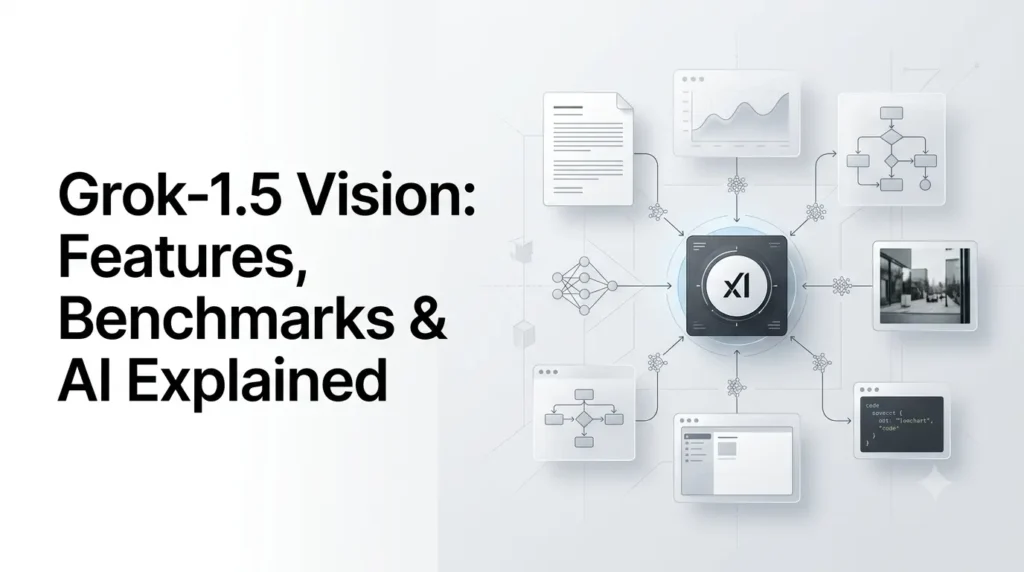
Grok-1.5 Vision (Grok-1.5V) was xAI’s first-generation multimodal Grok model, announced on April 12, 2024. It extended Grok beyond text by allowing the model to process documents, diagrams, charts, screenshots, and photographs.
xAI positioned Grok-1.5V as a preview for early testers and existing Grok users. The model was particularly focused on visual reasoning and understanding the physical world, with xAI introducing its RealWorldQA benchmark to evaluate spatial understanding from images.
Grok-1.5V is primarily important as a milestone in the development of xAI’s multimodal systems. Later Grok generations moved beyond this early vision model, making it useful to understand Grok-1.5V as part of the progression from the original text-based Grok models toward more capable multimodal AI.
Quick Summary
- Grok-1.5 Vision (Grok-1.5V) was xAI’s first-generation multimodal Grok model, announced in April 2024.
- It could understand documents, charts, diagrams, screenshots, and photographs.
- The model focused on visual reasoning and real-world image understanding.
- xAI demonstrated its ability to convert flowcharts into Python code.
- Grok-1.5V achieved strong results across benchmarks such as MMMU, MathVista, AI2D, ChartQA, and DocVQA.
- Its RealWorldQA benchmark focused on understanding real-world visual and spatial information.
- It was initially released as a preview for early testers and existing Grok users.
- Grok-2 and later generations eventually superseded Grok-1.5 Vision.
What Is Grok-1.5 Vision?
Grok-1.5 Vision, also called Grok-1.5V, is xAI’s first multimodal Grok model capable of processing both text and visual information.
The model could analyze several types of visual inputs, including:
- Photographs
- Screenshots
- Documents
- Charts
- Diagrams
- Real-world scenes
This meant users could provide an image and ask Grok to interpret what was shown rather than describing the image manually.
xAI described the model as a step toward connecting the digital and physical worlds, with particular attention to spatial understanding and visual reasoning.
When Was Grok-1.5 Vision Released?
xAI announced Grok-1.5 Vision Preview on April 12, 2024.
The announcement came only a few weeks after the company introduced Grok-1.5 on March 28, 2024. Grok-1.5 itself focused on stronger reasoning and a 128,000-token context length, while the Vision Preview extended the model family into multimodal understanding.
At launch, xAI described Grok-1.5V as a preview, rather than presenting it as a mature, broadly available multimodal platform.
The company said the model would initially become available to early testers and existing Grok users.
Why Was Grok-1.5V Important?
The significance of Grok-1.5V was not simply that it could recognize pictures.
Its importance came from combining visual inputs with the model’s language capabilities.
A conventional language model primarily works with text. A multimodal model can instead receive an image and reason about what it contains.
For example, Grok-1.5V could be given a flowchart and asked to turn the diagram into Python code. In its announcement, xAI demonstrated exactly this type of workflow.
That creates a more practical interface for tasks involving information that exists outside plain text.
What Could Grok-1.5V Understand?
xAI specifically highlighted several categories of visual information.
a) Documents
Grok-1.5V could process documents containing both text and visual structure.
This opened possibilities for tasks such as:
- Extracting information
- Understanding document layouts
- Answering questions about documents
- Interpreting structured information
- Combining visual and textual context
Document understanding is particularly useful because many real-world documents cannot be represented adequately as plain text.
b) Charts
The model could interpret charts and answer questions about their contents.
This can involve identifying:
- Trends
- Relationships
- Values
- Categories
- Visual comparisons
Chart understanding is different from simple image recognition because the model needs to connect visual structure with the question being asked.
c) Diagrams
Diagrams were another important capability.
xAI demonstrated Grok-1.5V interpreting a flowchart and converting its logic into Python code.
This is a useful example of multimodal reasoning because the model is not merely identifying objects. It needs to understand the relationship between elements in the diagram and translate that structure into an) other representation.
d) Screenshots
Grok-1.5V could also analyze screenshots.
This capability can be useful when the information being analyzed exists inside a software interface rather than a conventional document.
Examples include:
- Application interfaces
- Website screenshots
- Error messages
- Dashboard layouts
- Software workflows
e) Photographs
The model could process ordinary photographs and reason about objects and scenes.
xAI particularly emphasized real-world understanding, including spatial relationships between objects.
Grok-1.5V and RealWorldQA
One of the most distinctive parts of the Grok-1.5V announcement was RealWorldQA.
xAI created RealWorldQA to evaluate how well multimodal AI models understand spatial relationships in real-world images.
The initial dataset contained more than 700 images, including anonymized images captured from vehicles and other real-world photographs. Each example included a question with an objectively verifiable answer.
The benchmark was designed around questions that can look simple to humans but can still challenge AI systems.
Examples included questions about:
- Which object is larger
- Which direction a road permits traffic to travel
- Whether there is enough space to drive around an object
- Which direction an object is facing
This made RealWorldQA different from a benchmark focused purely on recognizing objects or reading text.
Grok-1.5V Benchmark Results
xAI compared Grok-1.5V against several multimodal models available at the time.
Its published results were:
| Benchmark | Grok-1.5V | GPT-4V | Claude 3 Sonnet | Claude 3 Opus | Gemini Pro 1.5 |
|---|---|---|---|---|---|
| MMMU | 53.6% | 56.8% | 53.1% | 59.4% | 58.5% |
| MathVista | 52.8% | 49.9% | 47.9% | 50.5% | 52.1% |
| AI2D | 88.3% | 78.2% | 88.7% | 88.1% | 80.3% |
| TextVQA | 78.1% | 78.0% | —— | —— | 73.5% |
| ChartQA | 76.1% | 78.5% | 81.1% | 80.8% | 81.3% |
| DocVQA | 85.6% | 88.4% | 89.5% | 89.3% | 86.5% |
| RealWorldQA | 68.7% | 61.4% | 51.9% | 49.8% | 67.5% |
These numbers come from xAI’s April 2024 evaluation. They should not be interpreted as a current ranking of multimodal AI models in 2026. Model capabilities and benchmark methodologies have changed substantially since then.
The results also show why it is misleading to describe Grok-1.5V simply as “better than all competing models.” It performed differently across individual evaluations, with stronger results on some tests and lower results on others.
What Was Grok-1.5V’s RealWorldQA Score?
Grok-1.5V achieved 68.7% on RealWorldQA in xAI’s published evaluation.
xAI reported this as higher than the comparison models listed in its announcement:
- Grok-1.5V: 68.7%
- GPT-4V: 61.4%
- Gemini Pro 1.5: 67.5%
- Claude 3 Sonnet: 51.9%
- Claude 3 Opus: 49.8%
The important qualification is that RealWorldQA was introduced by xAI as part of this release, so the benchmark should be understood in the context of xAI’s methodology rather than treated as a universal measure of multimodal intelligence.
How Did Grok-1.5V Handle Visual Reasoning?
Visual reasoning goes beyond identifying what appears in a picture.
A model may need to:
- Identify relevant objects.
- Understand their spatial relationships.
- Interpret the user’s question.
- Connect visual evidence to the question.
- Produce an answer in natural language.
Grok-1.5V was designed to perform this type of multimodal reasoning.
For example, if an image shows a road sign, vehicles and a particular lane, the task may require understanding the relationship between the sign, road layout and vehicle position rather than simply recognizing the individual objects.
Can Grok-1.5V Understand Images and Generate Images?
Grok-1.5V was primarily introduced as a multimodal understanding model.
xAI’s announcement focused on its ability to process and reason about visual information such as documents, charts, diagrams, screenshots and photographs. It did not present Grok-1.5V as an image-generation model.
This distinction matters because “multimodal” does not automatically mean that a model can generate every modality it can understand.
xAI explicitly said that improving both multimodal understanding and generation was part of its future direction, indicating that these were separate capabilities.
Grok-1.5V vs Grok-1.5
Grok-1.5 and Grok-1.5V were closely related but served different purposes.
| Feature | Grok-1.5 | Grok-1.5V |
|---|---|---|
| Release | March 28, 2024 | April 12, 2024 |
| Primary focus | Text, reasoning and coding | Multimodal understanding |
| Multimodal understanding | Text capabilities | Text + visual inputs |
| Text capabilities | Yes | Yes |
| Image understanding | Not the focus | Yes |
| Documents | Text-based processing | Visual document understanding |
| Charts | Not a primary capability | Yes |
| Screenshots | Not a primary capability | Yes |
| Photographs | Not a primary capability | Yes |
| Context length | 128K tokens | Not separately specified in the Vision announcement |
| RealWorldQA | No | Yes |
| Status at launch | Model release | Vision Preview |
Grok-1.5 was announced with a 128,000-token context length, whereas the Grok-1.5V announcement concentrated on multimodal capabilities and did not separately specify a context length.
Grok-1.5V vs Grok-1
The difference becomes even clearer when comparing the original Grok with the Vision model.
| Feature | Grok-1 | Grok-1.5V |
|---|---|---|
| Generation | First major Grok model | Grok-1.5 generation |
| Modality | Text | Text + visual inputs |
| Parameters | 314B | Not officially specified in Vision announcement |
| Architecture | Mixture of Experts | Not separately specified |
| Image understanding | No | Yes |
| Document understanding | Text model | Visual + text |
| Diagram understanding | Limited to textual descriptions | Direct visual processing |
| Real-world spatial benchmark | No | RealWorldQA |
| Release | 2023 / open release 2024 | April 2024 preview |
The original Grok-1 was released as a 314-billion-parameter Mixture-of-Experts model. xAI’s Grok-1.5V announcement did not publish a comparable parameter specification for the vision model, so it should not be assumed that Grok-1V used exactly the same architecture or parameter configuration.
Practical Use Cases for Grok-1.5V
The model’s capabilities point to several practical use cases.
1. Understanding Technical Diagrams
A user could provide a technical diagram and ask the model to explain the relationships between its components.
2. Converting Visual Logic Into Code
xAI demonstrated a flowchart-to-Python workflow, showing how visual information could become executable code.
3. Analyzing Charts
Users could ask questions about information represented visually in a chart.
4. Reading Screenshots
A screenshot can contain information that is difficult to communicate through plain text. Multimodal analysis allows the model to work directly from the visual interface.
5. Document Analysis
Visual document understanding can help when layout, tables, diagrams or other visual elements are important to the meaning.
6. Real-World Scene Understanding
Grok-1.5V was explicitly designed to improve understanding of the physical world, making scene and spatial reasoning an important part of its research direction.
What Were the Limitations of Grok-1.5V?
Grok-1.5V was introduced as a Vision Preview, so it should not be treated as a fully mature multimodal system by today’s standards.
Important limitations include:
- It was introduced as a preview rather than a final model.
- xAI did not publish every architectural specification.
- Benchmark results represented a specific 2024 evaluation.
- Performance varied significantly across benchmarks.
- Visual understanding does not guarantee factual accuracy.
- The model could potentially misinterpret ambiguous images.
- Real-world spatial reasoning remained an active research area.
- Current multimodal AI systems have advanced considerably beyond this generation.
Another important limitation is historical context. A benchmark score from April 2024 should not be directly compared with scores from models released years later without considering changes in datasets, evaluation methods and model capabilities.
Was Grok-1.5V Open Source?
No equivalent open-weight release of Grok-1.5V was announced alongside the Vision Preview.
This is different from the original Grok-1 release.
In March 2024, xAI released the weights and architecture of Grok-1, a 314-billion-parameter Mixture-of-Experts model.
The April 2024 Grok-1.5V announcement instead described the model as a preview available to early testers and existing Grok users.
Therefore, it is important not to describe Grok-1.5V as an open-source model simply because Grok-1 itself had an open release.
Was Grok-1.5V Available Through the API?
The original April 2024 announcement did not present Grok-1.5V as a general public API release. It described availability to early testers and existing Grok users.
xAI subsequently introduced its public API in November 2024, after the Grok-1.5V announcement. The company’s current product ecosystem has since moved through several newer generations.
As a result, readers should distinguish between:
- Historical Grok-1.5V preview availability
- Later xAI API availability
- Current xAI model availability
They are not the same thing.
What Happened After Grok-1.5V?
Grok-1.5V was followed by newer generations of Grok.
The major transition came with Grok-2, which xAI announced on August 13, 2024. The Grok-2 release represented another major step in the company’s model development and eventually superseded the early Grok-1.5 generation. xAI’s current news archive now lists Grok-2 alongside substantially newer Grok generations released in 2025 and 2026.
The broader progression can be simplified as:
Grok-1 → Grok-1.5 → Grok-1.5V → Grok-2 → later Grok generations
The sequence should not be interpreted as a strict replacement of every model on the same day. Some models served different purposes and were available through different products.
Why Grok-1.5 Vision Still Matters
Grok-1.5V is historically important because it marked xAI’s first generation of multimodal Grok.
Before this release, Grok was primarily associated with text-based interaction. Grok-1.5V expanded that direction by allowing the system to interpret visual information directly.
Its most important contributions were:
- Bringing image understanding into Grok
- Combining visual information with language reasoning
- Demonstrating diagram-to-code workflows
- Introducing RealWorldQA
- Exploring physical-world spatial understanding
- Establishing a foundation for later multimodal development
xAI itself said it expected to make significant improvements to multimodal understanding and generation across additional modalities, including audio and video, in the following months.
Conclusion
Grok-1.5 Vision was xAI’s first multimodal Grok model, announced on April 12, 2024. It expanded Grok from primarily text-based interaction into visual understanding, allowing the system to work with documents, diagrams, charts, screenshots and photographs.
Its introduction of RealWorldQA also showed xAI’s interest in evaluating how AI models understand physical scenes and spatial relationships rather than simply recognizing objects.
Grok-1.5V was eventually overtaken by newer Grok generations, but its role in xAI’s model history remains significant. It represents one of the company’s early steps toward the multimodal systems that later became a larger part of the Grok ecosystem.
Frequently Asked Questions
1. What is Grok-1.5 Vision?
Grok-1.5 Vision, or Grok-1.5V, is xAI’s first-generation multimodal Grok model. Announced in April 2024, it could process documents, diagrams, charts, screenshots and photographs alongside text.
2. When was Grok-1.5V released?
xAI announced Grok-1.5 Vision Preview on April 12, 2024. It was initially planned for early testers and existing Grok users.
3. What could Grok-1.5V do?
It could analyze visual information including photographs, screenshots, charts, diagrams and documents. xAI also demonstrated its ability to interpret a flowchart and generate corresponding Python code.
4. What is RealWorldQA?
RealWorldQA is a benchmark introduced by xAI to evaluate the ability of multimodal models to understand real-world spatial relationships. Its initial release contained more than 700 images with questions and verifiable answers.
5. Is Grok-1.5V still a current xAI model?
Grok-1.5V is primarily a historical model generation. xAI has since released Grok-2 and substantially newer generations, so current users should not confuse the 2024 Vision Preview with xAI’s latest multimodal capabilities.
6. Is Grok-1.5V the same as Grok-1.5?
No. Grok-1.5 was the March 2024 model focused on improved reasoning, coding and a 128K-token context window. Grok-1.5V was announced later as xAI’s first multimodal model, adding visual understanding capabilities.
Also Read
What Is Grok AI? Features, Use Cases, and How It Works?
Grok AI Features: Explore Everything Grok Can Do
Grok Safety and Moderation: Safety, Moderation, and Policy Changes Affecting Users