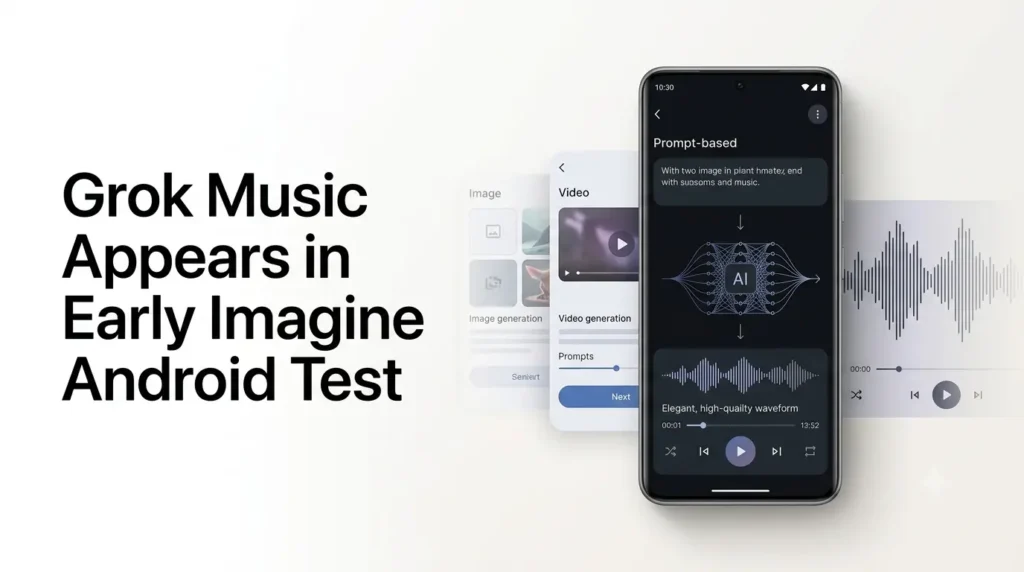
SpaceXAI appears to be testing Grok Music, a potential new music-generation capability inside its Imagine platform, according to an early Android preview shared on September 26, 2026. The reported feature appears to let users describe the kind of track they want and generate music from a prompt.
The development has not been officially announced by SpaceXAI, however. The company’s current public Imagine documentation continues to describe the platform primarily around image and video generation and editing, while its latest Grok Imagine Video 1.5 announcement highlights generated sound effects, ambience and dialogue for video.
That makes the reported Android preview significant as a possible product test, but it should not yet be treated as confirmation that Grok Music has launched or is generally available.
Quick Summary
- Grok Music appears to be undergoing an early test inside Grok Imagine.
- The reported preview was seen on Android.
- The feature appears to generate music from text prompts.
- xAI has not officially announced Grok Music as a public product.
- Current Imagine documentation focuses on image and video generation.
- Grok Imagine Video 1.5 already generates sound effects, ambience and dialogue for videos.
- Important details such as the music model, track length, vocals, pricing and licensing remain unconfirmed
What the Grok Music Preview Shows?
The reported preview comes from an Android build of Imagine and appears to show a music-generation workflow built directly into the creative interface.
According to the report, users can describe the type of track they want and have Grok generate an audio result. The preview reportedly demonstrated different musical styles, suggesting that the system may be capable of responding to relatively open-ended music prompts.
However, the available evidence does not establish the full scope of the feature. The preview does not provide verified information about the underlying model, maximum track length, vocal generation, editing controls, export formats or licensing terms.
The person sharing the preview also described it as a very early Android look and indicated that additional changes were needed to make the feature accessible. That suggests the interface may still be experimental and could change substantially before any potential public release.
How Grok Music Would Expand Imagine?
A music-generation feature would represent a notable expansion of what users can create through Imagine.
SpaceXAI currently positions Imagine as its image and video-generation platform. Its public documentation lists Grok Imagine Image 2.0 for image generation and editing and Grok Imagine Video 1.5 for video creation. The Imagine API supports workflows including text-to-image, image editing, text-to-video, image-to-video, video editing and video extension.
Music would introduce another creative medium into that workflow.
Instead of generating visual assets and then using a separate service to create a soundtrack, creators could potentially generate music within the same environment. That could be particularly useful for people producing short videos, social content, promotional material or other multimedia projects.
For now, however, that remains a potential use case rather than a confirmed capability of the public Imagine product.
Imagine Already Has AI-Generated Audio for Video
The reported Grok Music test would not be SpaceXAI’s first move into generative audio.
When SpaceXAI introduced Grok Imagine Video 1.5 in June 2026, it said the model could generate sound effects, ambience and dialogue in the same pass as the video. The company also described improvements to audio quality and speech synchronization. Video 1.5 Fast was rolled out to Grok’s web and mobile Imagine experiences.
This distinction is important.
Generating audio as part of a video is different from offering a standalone text-to-music system. A dedicated music feature would need to create an independent musical track rather than simply supplying sound for a generated scene.
SpaceXAI’s current Imagine API documentation does not list a standalone music-generation model alongside its image and video models. Its published model lineup currently identifies Grok Imagine Image 2.0 for images and Grok Imagine Video 1.5 for videos.
What Is Still Unknown About Grok Music?
Several important details remain unconfirmed.
- The underlying model: SpaceXAI has not publicly identified a Grok Music model or provided technical documentation describing how music generation would work.
- Track length and controls: The preview does not establish whether users can specify duration, structure, tempo, instrumentation or other musical parameters.
- Vocals and lyrics: There is currently no reliable evidence establishing whether the reported system can create sung vocals, generate lyrics or produce instrumental-only tracks.
- Editing: It is unclear whether users can extend, remix, revise or regenerate specific sections of a track.
- Availability: The reported preview appears limited to an early Android test. There is no verified evidence that the feature is broadly available across Grok’s web or iOS applications.
- Pricing and licensing: SpaceXAI has not publicly documented pricing, commercial-use terms or licensing conditions for a standalone music-generation capability.
These limitations are important because a working preview does not necessarily indicate that a feature is ready for general release.
Grok Music Would Enter an Established AI Music Market
If SpaceXAI eventually releases Grok Music as a standalone generation feature, it would enter an AI music market that already includes dedicated text-to-music services.
The potential distinction for Imagine would be its integration with SpaceXAI’s existing generative-media workflow. Imagine already combines image and video creation, while Video 1.5 adds generated audio to video production. A standalone music feature could potentially extend that workflow into another medium.
But the current preview does not provide enough evidence to determine how Grok Music would compare with dedicated AI music-generation platforms in areas such as song quality, editing, consistency, track duration or licensing.
Those comparisons will only become meaningful if SpaceXAI officially documents and releases the feature.
What SpaceXAI Officially Offers in Imagine Today?
For now, the publicly documented Imagine platform remains centered on image and video creation.
The current Imagine API supports Grok Imagine Image 2.0 for image generation and editing, including multi-image editing, while Grok Imagine Video 1.5 supports video generation from text or images, video editing, reference-to-video and related workflows.
SpaceXAI’s model documentation likewise lists Imagine under image and video generation rather than standalone music generation.
That makes the reported Grok Music preview best understood as an early product-development signal, rather than a confirmed launch.
If the feature progresses beyond testing, it could turn Imagine into a broader generative-media environment covering images, video and music. For now, the public evidence supports the narrower conclusion that an early Android preview reportedly shows music generation being tested, while SpaceXAI has yet to officially document or announce Grok Music.
Also Read –
Grok Imagine AI Video Generation Tops Leaderboard
Source
SpaceXAI- Grok Imagine Video 1.5
RuntimeWire – SpaceXAI may be testing Grok music generation inside Imagine