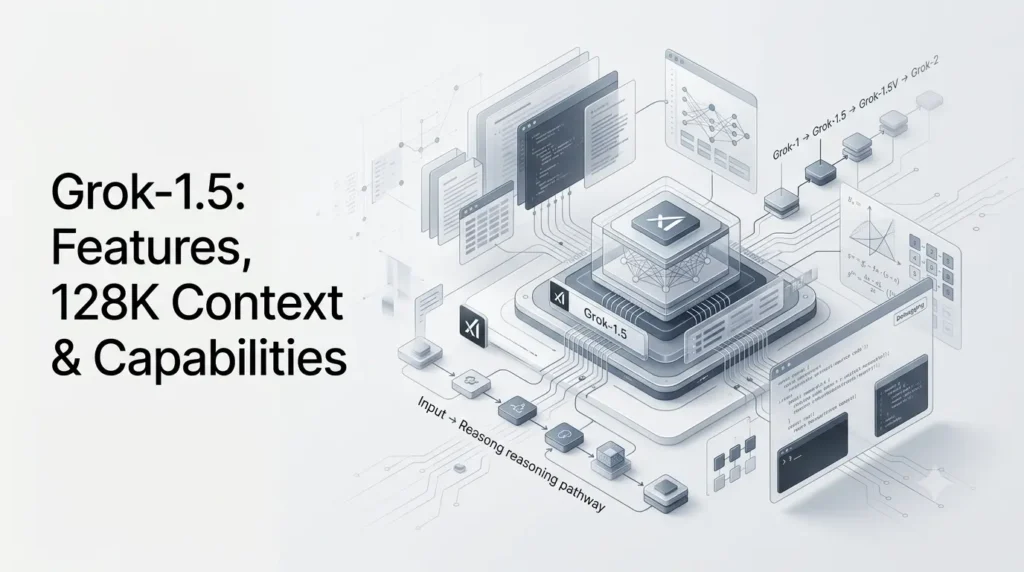
Grok-1.5 was xAI’s major upgrade to its original Grok language model, introducing substantially stronger reasoning, coding and mathematics capabilities along with a much larger 128,000-token context window. Announced on March 28, 2024, it was designed to understand much longer prompts and documents while improving performance on difficult reasoning and programming tasks.
Grok-1.5 was an important transition point in the early Grok model family. It followed the original Grok-1 and preceded Grok-1.5V, the first multimodal Grok model, and later Grok-2.
Although Grok-1.5 is no longer a current-generation Grok model in 2026, it remains important for understanding how xAI moved from its first language model toward longer-context, reasoning and multimodal systems.
Quick Summary
- Grok-1.5 was xAI’s major 2024 upgrade to the original Grok model.
- It introduced a 128K-token context window for handling longer inputs.
- It delivered stronger reasoning, coding, mathematics, and problem-solving capabilities.
- xAI reported notable benchmark improvements over Grok-1.
- Grok-1.5V later added multimodal understanding for images, charts, documents, and screenshots.
- Grok-1.5 was eventually followed by Grok-2 and newer Grok generations.
- It remains an important milestone in the evolution of xAI’s AI models.
What Is Grok-1.5?
Grok-1.5 was an upgraded large language model from xAI focused on reasoning, problem solving, coding and long-context understanding.
xAI announced the model on March 28, 2024, describing it as its latest model for advanced reasoning and long-context tasks. The company initially planned to make it available to early testers and existing Grok users on X.
The biggest changes compared with the original Grok-1 were:
- A 128K-token context window
- Improved mathematical reasoning
- Better coding performance
- Stronger problem-solving capabilities
- Better handling of long and complex prompts
- Improved retrieval of information from long contexts
- A new training infrastructure designed for large distributed GPU clusters
Grok-1.5 therefore represented more than a simple incremental update. It significantly expanded the amount of information the model could process in a single context.
When Was Grok-1.5 Released?
xAI announced Grok-1.5 on March 28, 2024.
At launch, xAI said the model would initially become available to early testers and existing Grok users on X in the following days.
The timeline surrounding the model is important:
| Date | Development |
|---|---|
| November 2023 | Original Grok announced |
| March 17, 2024 | xAI released Grok-1 weights and architecture |
| March 28, 2024 | Grok-1.5 announced |
| April 12, 2024 | Grok-1.5V, the first multimodal Grok model, announced |
| August 13, 2024 | Grok-2 introduced as the next major generation |
xAI later described Grok-2 as a significant step forward from Grok-1.5, particularly in chat, coding and reasoning.
What Was New in Grok-1.5?
The most important improvement was the combination of stronger reasoning with much longer context.
a) 128K Context Window
Grok-1.5 could process up to 128,000 tokens within its context window.
That was a major increase from the original Grok-1’s 8,192-token context. xAI described the new context length as up to 16 times larger than the previous model.
A larger context window allows a model to work with substantially more information at once.
For example, instead of processing a relatively short document or code sample, a 128K context window could accommodate much larger collections of:
- Documents
- Source code
- Technical specifications
- Research material
- Long conversations
- Multiple related files
The context window should not be confused with the model’s permanent memory. It describes how much information can be supplied within the model’s active context for a task.
b) Improved Reasoning
xAI specifically highlighted improved reasoning and problem-solving in Grok-1.5.
The company reported substantial gains on mathematics and coding benchmarks compared with Grok-1.
This made the model more useful for tasks requiring multiple reasoning steps rather than straightforward text generation.
c) Better Coding
Coding was one of Grok-1.5’s highlighted improvements.
xAI reported a 74.1% score on HumanEval, compared with 63.2% for Grok-1 in its published comparison. HumanEval evaluates code-generation ability.
This improvement was part of xAI’s broader focus on problem solving and technical tasks.
d) Stronger Mathematics
Grok-1.5 also showed substantial improvement on mathematics benchmarks.
xAI reported:
- 50.6% on MATH
- 90% on GSM8K
For comparison, the company’s published Grok-1 results were 23.9% on MATH and 62.9% on GSM8K.
These are historical benchmark results reported by xAI in March 2024. They should not be interpreted as measurements of the performance of current Grok models.
Grok-1.5 Benchmark Performance
xAI’s original announcement compared Grok-1.5 with Grok-1 and several other models using several established benchmarks.
| Benchmark | Grok-1 | Grok-1.5 |
|---|---|---|
| MMLU | 73% | 81.3% |
| MATH | 23.9% | 50.6% |
| GSM8K | 62.9% | 90% |
| HumanEval | 63.2% | 74.1% |
xAI specified different evaluation settings for the benchmarks, including 5-shot MMLU, 4-shot MATH, 8-shot GSM8K and 0-shot HumanEval.
The results indicate that Grok-1.5 represented a substantial improvement over Grok-1 on the benchmarks xAI reported.
However, benchmark scores should be read in context. Different models can be evaluated using different prompting, sampling and evaluation methodologies, so a benchmark table does not by itself establish how a model will perform on every real-world task.
How Does the 128K Context Window Help?
The larger context window was arguably one of Grok-1.5’s most practical improvements.
Consider a developer working with a large codebase.
With a smaller context window, the developer may need to provide only selected files or sections. With a 128K-token context, substantially more material can potentially be supplied in one request.
The same principle applies to research.
A user could provide:
- A long research paper
- Supporting notes
- Tables or excerpts
- A list of questions
The model can then reason over that larger collection of information within the same context.
xAI specifically tested Grok-1.5 using a Needle In A Haystack (NIAH) evaluation and reported successful retrieval of embedded information across contexts up to 128K tokens.
This demonstrated the model’s ability to retrieve information positioned at different locations within a very long context.
What Could Grok-1.5 Be Used For?
Grok-1.5’s capabilities made it relevant to several categories of work.
i) Coding
Grok-1.5 could assist with:
- Generating code
- Explaining programming concepts
- Solving coding problems
- Reviewing code
- Working through programming challenges
Its HumanEval score was one of the benchmark results xAI used to demonstrate the model’s coding improvement.
ii) Mathematics
The model’s stronger MATH and GSM8K results made mathematical problem solving another important use case.
It could be used to work through structured mathematical problems and explain solutions, although benchmark performance should not be interpreted as proof that every mathematical answer would be correct.
iii) Long Documents
The 128K context window made Grok-1.5 particularly relevant to long-document workflows.
Potential applications included:
- Summarizing lengthy documents
- Extracting information from large files
- Comparing sections of a document
- Answering questions about long technical material
- Analyzing extended conversations
iv) Research
A larger context can be useful when a task requires several pieces of information to remain available simultaneously.
For example, a researcher could provide multiple sections of a technical document and ask the model to identify relationships between them.
The important distinction is that a large context window provides more working context, not necessarily more factual knowledge.
How Was Grok-1.5 Trained?
xAI also discussed the infrastructure used to train Grok-1.5.
The model was trained using a custom distributed training framework based on:
- JAX
- Rust
- Kubernetes
xAI said the infrastructure was designed to support large GPU clusters while improving reliability, checkpointing, data loading and recovery from hardware failures.
The company described an orchestration system that could identify problematic compute nodes and remove them from training jobs.
This infrastructure detail is useful because training a large language model is not simply a matter of running a conventional machine-learning script. Large-scale training requires systems for distributing computation, managing failures and coordinating huge amounts of data and model state.
Was Grok-1.5 an Open-Source Model?
This is an area where Grok-1.5 is often confused with Grok-1.
xAI released the Grok-1 weights and architecture under the Apache 2.0 license in March 2024.
Grok-1.5, however, was not released in the same way as the open-weight Grok-1 model.
xAI’s Grok-1.5 announcement discussed availability to early testers and existing Grok users, but it did not announce an equivalent open-weight release of Grok-1.5.
Therefore, it is inaccurate to describe Grok-1.5 as the open-source successor to Grok-1.
A useful distinction is:
| Model | Open-weight release |
|---|---|
| Grok-1 | Yes |
| Grok-1.5 | No equivalent official open-weight release announced |
| Grok-1.5V | No equivalent official open-weight release announced |
| Grok-2 | Hosted/API model rather than an equivalent open-weight release |
Grok-1 vs Grok-1.5
The simplest way to understand the upgrade is to compare the original model with its successor.
| Feature | Grok-1 | Grok-1.5 |
|---|---|---|
| Announcement | November 2023 | March 2024 |
| Context length | 8,192 tokens | 128,000 tokens |
| MMLU | 73% | 81.3% |
| MATH | 23.9% | 50.6% |
| GSM8K | 62.9% | 90% |
| HumanEval | 63.2% | 74.1% |
| Reasoning | Initial capability | Improved |
| Coding | Supported | Improved |
| Long-context understanding | Limited compared with 1.5 | Major focus |
| Open-weight release | Yes | No equivalent release announced |
The benchmark figures above come from xAI’s March 2024 announcement and use the evaluation settings specified by the company.
Grok-1.5 vs Grok-1.5V
Grok-1.5V was not simply a renamed version of Grok-1.5. It was a multimodal model introduced shortly afterward.
xAI announced Grok-1.5V on April 12, 2024, describing it as the first-generation multimodal model in the Grok family. It could process visual information including:
- Documents
- Diagrams
- Charts
- Screenshots
- Photographs
This distinction matters because standard Grok-1.5 was primarily discussed in terms of text, reasoning, coding and long-context capabilities, while Grok-1.5V expanded Grok into visual understanding.
Grok-1.5 vs Grok-1.5V
| Capability | Grok-1.5 | Grok-1.5V |
|---|---|---|
| Text understanding | Yes | Yes |
| Reasoning | Improved | Improved |
| Coding | Improved | Supported |
| 128K context | Yes | Based on the Grok-1.5 generation |
| Image understanding | Not the primary announced capability | Yes |
| Documents | Text-focused | Visual document understanding |
| Charts | Text-based analysis | Visual chart understanding |
| Screenshots | Not the primary announced capability | Yes |
| Photographs | Not the primary announced capability | Yes |
Grok-1.5V’s visual capabilities represented the next major expansion of the early Grok family.
What Were the Limitations of Grok-1.5?
Grok-1.5 was a significant improvement over Grok-1, but it was not equivalent to the later Grok systems.
a) It Was an Early-Generation Model
Grok-1.5 was released in 2024. Later Grok generations introduced substantially broader capabilities.
For example, xAI’s 2024 Grok-2 announcement described improvements over Grok-1.5 across reasoning, knowledge, mathematics, coding and vision-related tasks.
Consequently, historical benchmark numbers for Grok-1.5 should not be used as a proxy for current Grok performance.
b) No Modern Multimodal Feature Set
The dedicated multimodal expansion came with Grok-1.5V.
It is therefore misleading to attribute the later Grok ecosystem’s complete image, video, voice or other multimodal capabilities to the original Grok-1.5 model.
c) No Current API Availability
xAI did not have its current public API ecosystem when Grok-1.5 launched.
The company’s public API beta was announced later, in November 2024, after Grok-2 had already been introduced.
As a result, readers searching for a current “Grok-1.5 API” should be careful: current xAI API documentation focuses on newer models, and Grok-1.5 should be treated as a historical model rather than a currently served API model.
Is Grok-1.5 Still Available?
Grok-1.5 should be considered a historical model generation, not a current model offered as part of xAI’s modern lineup.
xAI’s subsequent releases moved the Grok family forward, with Grok-2 introduced in August 2024 and considerably newer generations following afterward.
Current xAI API documentation now lists modern Grok models such as Grok 4.7, Grok 4.6 and Grok 4.5 rather than Grok-1.5.
Therefore, someone looking to use Grok today should not expect to find Grok-1.5 as a current API model.
How Did Grok-1.5 Lead to Later Grok Models?
Grok-1.5 helped establish several directions that became increasingly important in later models.
The progression can be viewed as:
Grok-1 → Grok-1.5 → Grok-1.5V → Grok-2 → Grok-3 → Grok-4 and later generations
Grok-1 established the foundation.
Grok-1.5 emphasized:
- Reasoning
- Mathematics
- Coding
- Long-context processing
Grok-1.5V added:
- Image understanding
- Document vision
- Diagram understanding
- Chart understanding
- Screenshot analysis
Grok-2 then expanded the model family further across reasoning, coding, knowledge and vision. xAI explicitly described Grok-2 as a significant advancement over Grok-1.5.
This makes Grok-1.5 an important bridge between the original text-focused Grok model and the increasingly multimodal and capable systems that followed.
Grok-1.5 vs Later Grok Models
It is useful to avoid treating every Grok model as a direct specification upgrade.
| Generation | Major focus |
|---|---|
| Grok-1 | Original language model |
| Grok-1.5 | Reasoning, coding and long-context understanding |
| Grok-1.5V | Multimodal visual understanding |
| Grok-2 | Stronger reasoning, coding, knowledge and vision |
| Grok-3 | Advanced reasoning and agent-oriented capabilities |
| Grok-4 and later | More advanced reasoning, tools, agents and multimodal capabilities |
The later generations represent substantial architectural and product evolution, so Grok-1.5’s specifications should be viewed within their 2024 context.
Why Does Grok-1.5 Matter?
Grok-1.5 matters because it demonstrated how quickly xAI was developing the original Grok system.
The model arrived only months after Grok-1 but expanded the context window from 8K to 128K tokens and substantially improved xAI’s reported mathematics and coding benchmark results.
It also served as a stepping stone toward multimodal Grok.
Less than three weeks after the Grok-1.5 announcement, xAI introduced Grok-1.5V, bringing visual understanding into the model family.
For the history of AI models, this makes Grok-1.5 notable not simply because of its benchmark scores, but because it marked a rapid expansion in context length, reasoning and technical capabilities.
Conclusion
Grok-1.5 was a major early milestone in xAI’s Grok model family. Announced in March 2024, it expanded the original Grok architecture with a 128K-token context window, stronger reasoning, improved mathematics performance and better coding capabilities.
Its importance is also tied to what came next. Grok-1.5V introduced visual understanding shortly afterward, while Grok-2 continued the progression with broader improvements across reasoning, coding, knowledge and vision.
Grok-1.5 is no longer a current model, but it represents an important stage in the transition from the original Grok-1 toward the much broader Grok ecosystem that exists today.
Frequently Asked Questions
1. What is Grok-1.5?
Grok-1.5 was xAI’s 2024 language model designed to improve reasoning, mathematics, coding and long-context understanding. It introduced a 128,000-token context window and was announced on March 28, 2024.
2. How many tokens could Grok-1.5 handle?
Grok-1.5 supported a context window of up to 128,000 tokens, compared with 8,192 tokens for the original Grok-1.
3. Was Grok-1.5 open source?
No equivalent official open-weight release of Grok-1.5 was announced. xAI did release the weights and architecture of Grok-1 under the Apache 2.0 license in March 2024.
4. What was the difference between Grok-1.5 and Grok-1.5V?
Grok-1.5 focused on improved reasoning, coding and long-context processing. Grok-1.5V added multimodal visual understanding, including the ability to process documents, diagrams, charts, screenshots and photographs.
5. Is Grok-1.5 still available?
Grok-1.5 is a historical model generation and is not part of the current xAI API model lineup. Current xAI documentation focuses on newer Grok generations.
6. What came after Grok-1.5?
Grok-1.5 was followed by Grok-1.5V and then Grok-2. xAI introduced Grok-2 in August 2024 as a significant step forward from Grok-1.5 in chat, coding and reasoning.
Also Read –
Grok AI Features: Explore Everything Grok Can Do
Grok Safety and Moderation: Safety, Moderation, and Policy Changes Affecting Users