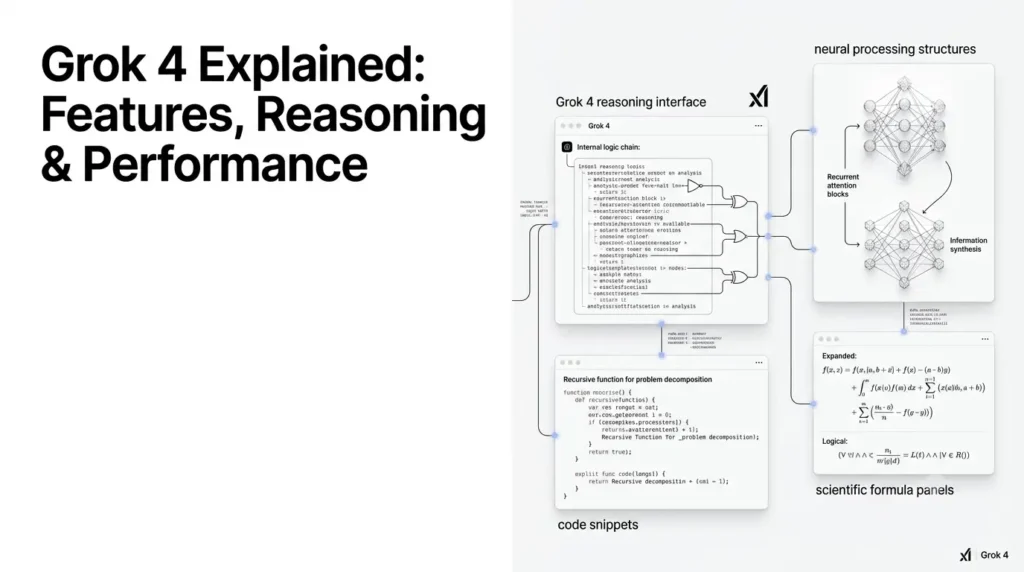
Grok 4 is xAI’s reasoning-focused AI model introduced on July 9, 2025.
It brought stronger mathematical and scientific reasoning, native tool use, web and X search integration, and an advanced version called Grok 4 Heavy. It marked a major step beyond Grok 3 by emphasizing longer reasoning and tool-assisted problem-solving.
However, Grok 4 is no longer xAI’s newest model generation. By October 2026, xAI has introduced later versions, including Grok 4.5, Grok 4.6, and Grok 4.7.
The original Grok 4 API identifier was also retired in May 2026 and now redirects to a newer model. This distinction matters if you’re researching Grok 4’s original capabilities or deciding which model to use today.
Quick Summary
- Grok 4 is an AI model developed by xAI, designed for advanced reasoning, coding, mathematics, scientific problem-solving, and research.
- It introduced enhanced reasoning capabilities and tool use, including web search and access to information from X.
- Grok 4 Heavy uses additional computational resources and parallel reasoning to tackle more complex problems.
- xAI reported strong results on selected mathematics, science, and reasoning benchmarks, though performance varies by task and testing conditions.
- Newer models, including Grok 4.6 and Grok 4.7, have expanded the Grok 4 generation with improvements for coding, general-purpose tasks, and AI agents.
What Is Grok 4?
Grok 4 is a large language model developed by xAI, the company behind the Grok chatbot available through Grok.com and X.
It was designed to handle demanding reasoning tasks, including mathematics, scientific questions, coding, research, and complex instructions.
Unlike a model that primarily responds from its existing training, Grok 4 was trained to use tools such as web browsing and code execution when they could help solve a problem.
It could also search X for relevant posts and information, making it useful for tasks involving public discussions and current events.
The original release introduced two main options:
- Grok 4: The main model for reasoning, coding, research, and general-purpose tasks.
- Grok 4 Heavy: A higher-compute version designed to consider multiple hypotheses and work on difficult problems using parallel reasoning approaches.
These models were introduced in July 2025. Later versions have extended the Grok 4 family, so the original release should be distinguished from the current models available through xAI.
When Was Grok 4 Released?
xAI announced Grok 4 on July 9, 2025, alongside Grok 4 Heavy and a new SuperGrok Heavy subscription tier. The launch followed Grok 3 and its reasoning-focused variants.
The release emphasized scaling reinforcement learning, expanding training data beyond mathematics and coding, and teaching the model to use tools during problem-solving.
xAI said its training infrastructure used the Colossus GPU cluster and reported substantial improvements in compute efficiency during training. These details come from xAI’s own launch announcement rather than an independent audit.
The subsequent model lineage includes:
| Model | Release period | Main emphasis |
|---|---|---|
| Grok 4 | July 2025 | Reasoning, tool use, mathematics, science, and coding |
| Grok 4 Heavy | July 2025 | Parallel reasoning and higher-compute problem-solving |
| Grok 4.1 | November 2025 | Better conversational quality, creativity, and response helpfulness |
| Grok 4.5 | 2026 | Coding, agentic workflows, and knowledge work |
| Grok 4.6 | August 2026 | Long-running agents, coding, and interactive projects |
| Grok 4.7 | September 2026 | Current flagship model for coding and general-purpose work, according to xAI’s model documentation |
The later models build on the original Grok 4 generation, but they should not be treated as identical versions.
Their availability, capabilities, context limits, and pricing differ.
What Are the Main Features of Grok 4?
Grok 4’s central features combine reasoning with tools that help it investigate and solve problems.
1. Advanced Reasoning
Grok 4 was designed to spend more computational effort on difficult problems instead of immediately producing a short answer. Its training emphasized reinforcement learning, allowing the model to improve at tasks where solutions can be evaluated or verified.
This approach is useful for problems involving multiple steps, such as:
- Breaking down a complex mathematical question.
- Comparing scientific explanations.
- Finding errors in code.
- Evaluating competing solutions to a technical problem.
- Organizing a research task into smaller questions.
Reasoning does not guarantee correctness.
The model can still make flawed assumptions, overlook important evidence, or produce an incorrect answer with confidence.
Important calculations and factual claims should be checked.
2. Native Tool Use
Grok 4 was trained to use tools as part of its problem-solving process.
Rather than relying entirely on its internal knowledge, it can use supported tools to gather information or perform calculations.
Examples include:
- Searching the web for relevant information.
- Searching X for public posts and discussions.
- Using code execution for calculations or programming tasks.
- Gathering evidence before preparing a research summary.
Tool use is particularly valuable when a task requires current information or a calculation that benefits from execution.
The quality of the final response still depends on the reliability of the sources, the instructions, and the model’s interpretation.
3. Real-Time Web and X Search
Grok’s integration with web search and X search was an important part of the original Grok 4 release.
Web search can help answer questions about recent announcements, product changes, public reports, and developing events. X search can be useful for finding public conversations, reactions, and posts related to a particular topic.
For example, a marketer researching a new AI product could ask Grok to locate its official announcement, collect recent commentary, and summarize the main points of disagreement.
Search results should not be treated as automatically verified facts.
Social posts can be inaccurate, and search tools can miss relevant sources. For important research, prioritize original announcements and supporting documentation.
4. Mathematics and Scientific Problem-Solving
xAI positioned Grok 4 as a model for challenging mathematics and science questions.
Its reinforcement-learning training emphasized verifiable tasks, where a solution can be checked against a known result or a formal evaluation.
Potential applications include:
- Working through mathematical problems.
- Explaining scientific concepts.
- Analyzing equations.
- Helping debug numerical code.
- Reviewing technical explanations.
- Exploring hypotheses before consulting primary research.
For advanced scientific work, Grok 4 is best used as an assistant rather than an unquestioned authority.
It can help structure a problem and suggest approaches, but researchers still need to verify calculations, references, and conclusions.
5. Coding and Technical Assistance
Grok 4 can help explain code, write functions, troubleshoot errors, and reason about software design.
Tool use can make the workflow more useful because the model may be able to execute code or research a technical issue when the required tools are enabled.
A developer might ask it to identify why a function fails, propose a correction, and explain how to test the change. For more complex projects, the developer should provide relevant code, error messages, expected behavior, and constraints.
The original Grok 4 release was an important step toward more tool-oriented coding workflows.
For new development work in October 2026, however, xAI recommends newer models such as Grok 4.7 for coding and general-purpose tasks.
6. Vision and Multimodal Understanding
Original Grok 4 API documentation described support for text and image inputs, with text output. This allowed developers to build workflows in which the model could interpret an image alongside written instructions.
Possible applications include explaining a chart, interpreting a screenshot, reviewing a diagram, or answering questions about a visual document.
Image understanding is different from image generation.
Grok 4’s language-model capabilities should not be confused with xAI’s separate Imagine image and video generation models, which have their own capabilities and pricing.
7. Voice and Visual Interaction
At the Grok 4 launch, xAI also highlighted an upgraded Voice Mode that could support more natural spoken conversations and camera-based visual interaction in the Grok app.
These are product-level features, not proof that every capability is built into the same API model. Access can depend on the app, subscription, region, and current rollout.
Developers should consult the relevant voice and vision documentation rather than assume that all Grok 4 interfaces support identical features.
What Is Grok 4 Heavy?
Grok 4 Heavy is the higher-compute version introduced alongside
Grok 4. Its defining idea was to use parallel test-time computation, allowing multiple reasoning paths or agents to consider a difficult problem.
In practical terms, this approach can be helpful when a question has several plausible solutions and requires more extensive evaluation. Instead of relying on a single reasoning path, the system can consider alternatives before producing a response.
xAI reported that Grok 4 Heavy achieved strong results on academic benchmarks, including a score above 50% on a text-only subset of Humanity’s Last Exam. These were company-reported results under particular evaluation conditions, not a guarantee of performance on every real-world task.
Grok 4 Heavy was aimed at demanding tasks rather than everyday quick questions.
Its availability and plan requirements have changed over time, so users should check xAI’s current product and pricing pages instead of assuming the original SuperGrok Heavy offering remains unchanged.
What are the performance and benchmark results for Grok 4?
xAI’s launch announcement presented Grok 4 as a substantial advance in reasoning performance. It reported results across mathematics, science, coding, and general reasoning evaluations.
Some of the evaluations discussed at launch included:
| Benchmark | What it evaluates |
|---|---|
| Humanity’s Last Exam | Difficult questions across a broad range of academic subjects |
| GPQA | Graduate-level science questions |
| USAMO 2025 | Advanced mathematical problem-solving |
| AIME 2025 | Competition mathematics |
| LiveCodeBench | Programming and coding performance |
| ARC-AGI-2 | Abstract reasoning and novel problem-solving |
xAI reported strong results for Grok 4 and Grok 4 Heavy, including a 50.7% result for Grok 4 Heavy on a text-only subset of Humanity’s Last Exam and 61.9% on USAMO 2025.
The company also reported a 15.9% result on ARC-AGI-2 for Grok 4 under its stated evaluation conditions.
These figures need context. Benchmarks can differ in tool access, reasoning time, test subsets, and scoring methodology.
A model evaluated with web search or code execution may perform differently from one tested without tools. Results from different model generations should not be compared without checking whether their evaluation setups are equivalent.
For readers choosing a model today, historical Grok 4 scores are useful for understanding the original release. They are less useful than current evaluations when deciding which model to use for a new project.
Which model is better?: Grok 4 vs Grok 3
Grok 4 followed Grok 3 with an increased emphasis on reinforcement learning, deeper reasoning, and native tool use.
| Feature | Grok 3 | Grok 4 |
|---|---|---|
| Generation | Earlier model generation | Released July 2025 |
| Reasoning | Included reasoning-focused variants | Greater emphasis on scaled reinforcement learning |
| Tool use | Supported tools in relevant workflows | Trained to select and use tools during problem-solving |
| Web and X search | Available in supported workflows | Central part of the announced tool-use approach |
| Mathematics and science | Strong reasoning focus | Further emphasis on difficult, verifiable tasks |
| Higher-compute option | Grok 3 Heavy | Grok 4 Heavy |
| Current status | Original model identifier retired in May 2026 | Original grok-4-0709 API identifier retired in May 2026 |
The main distinction is the original Grok 4 release’s stronger focus on reasoning at scale and integrated tool use. However, the original Grok 3 API identifier and grok-4-0709 were retired on May 15, 2026.
Requests to those identifiers are redirected to Grok 4.3 with specified reasoning settings. That means an old API request may no longer run the exact model it originally targeted.
What are the key differences between Grok 4, Grok 4.6, and Grok 4.7?
If you’re deciding which Grok model to use now, comparing Grok 4 with later releases is more useful than treating it as the current flagship.
| Model | Main emphasis | Current relevance |
|---|---|---|
| Grok 4 | Original reasoning-focused release and native tool use | Useful for understanding the 2025 generation |
| Grok 4.6 | Long-running agents, coding, knowledge work, and interactive projects | Later model with published API availability and pricing |
| Grok 4.7 | Coding, agentic tool calling, and general-purpose work | Listed as the flagship in current xAI model documentation |
xAI’s August 2026 announcement describes Grok 4.6 as better suited to sustained, multi-step tasks, including researching unfamiliar topics, working across a codebase, and turning an idea into a functional application.
Its September 2026 documentation identifies Grok 4.7 as the flagship model for code and general-purpose tasks.
Recommendation: If you’re learning about Grok 4’s original features, the 2025 model remains relevant historical context. If you’re choosing a model for current coding, research, or agentic workflows, start by evaluating Grok 4.7 or another currently supported model that fits your needs.
Is Grok 4 Free?
Grok has a free access tier, but availability of particular models and features depends on current usage limits and subscription terms.
The original Grok 4 launch made the model available to SuperGrok and X Premium+ subscribers, as well as through the xAI API.
By October 2026, xAI’s subscription structure and product lineup have changed.
The current pricing page lists Free, Plus, Premium, Super, Ultra, Teams, and Enterprise options.
It lists Plus at $8 per month, Premium at $30, Super at $100, and Ultra at $200, before applicable taxes and fees. The included usage and feature access differ by tier.
| Access route | What to know |
|---|---|
| Free | Limited AI usage; specific model access can vary |
| Paid subscriptions | Higher usage and feature access according to the selected plan |
| xAI API | Usage-based billing, with model-specific rates |
| Business and enterprise | Additional administrative, privacy, and support options may apply |
These are current subscription tiers, not the original Grok 4 launch pricing. Do not assume that buying a current subscription gives access to the original July 2025 model specifically.
Check the live model selector and plan details before subscribing.
What is included in the Grok 4 developer API platform?
The xAI API allows developers to integrate Grok models into applications and workflows. At launch, xAI described Grok 4 as supporting text and image inputs, a 256,000-token context window, and tool-assisted search.
Those are historical specifications for the original release, not the specifications of every later Grok model.
There is an important API detail for developers: the original grok-4-0709 model identifier was retired in May 2026. xAI's migration documentation says requests to that identifier now redirect to Grok 4.3 with low reasoning effort.
Developers who need predictable behavior should select a currently supported model explicitly rather than rely on the old identifier.
For new API projects:
- Check the current model catalogue.
- Choose a model based on reasoning needs, context size, latency, and cost.
- Review whether web search, X search, or code execution needs to be enabled.
- Test with representative prompts and expected outputs.
- Recheck pricing and model aliases before deploying to production.
API pricing is usage-based and varies by model. For example, xAI’s current documentation lists Grok 4.7 at $2 per million input tokens and $6 per million output tokens for shorter-context requests, with different rates for longer contexts and cached input.
Those rates apply to Grok 4.7, not the original Grok 4 model.
What Are Grok 4’s Limitations?
Grok 4 improved reasoning and tool use, but it still has limitations that matter in everyday and professional work.
1. It can still make mistakes
Reasoning models can produce incorrect answers, misinterpret evidence, or miss constraints. A long explanation is not proof that the answer is correct.
Check important claims, calculations, code, and sources.
2. Search does not guarantee accuracy
Web and X search can improve freshness, but search results may be incomplete, outdated, or misleading.
For research, check original sources and distinguish official announcements from speculation or user-generated posts.
3. More reasoning can take more time
A model that uses additional computation or several tool calls may take longer than one answering a simple question. Not every task benefits from the highest reasoning effort.
4. Model access changes over time
Grok 4 has been superseded by later models, and its original API identifier has been retired.
Articles, tutorials, and code examples that treat the July 2025 release as the current flagship may be outdated.
5. Benchmarks are not guarantees
Strong results on mathematics, coding, or academic benchmarks do not ensure that the model will outperform every alternative on a specific business task.
Real-world performance depends on the task, tools, instructions, and evaluation criteria.
Who Should Use Grok 4?
The original Grok 4 is most relevant to readers studying xAI’s reasoning-model development or comparing the capabilities introduced in 2025.
Its capabilities and the later models in its lineage are relevant to:
- Students and researchers: Explore complex questions, structure research, and work through technical problems while verifying important claims.
- Developers: Explain code, debug functions, research APIs, and design multi-step coding workflows.
- Content creators and marketers: Research current topics, compare public reactions, and outline content based on sourced information.
- Technical teams: Investigate problems that benefit from code execution, external search, or multi-step reasoning.
- AI enthusiasts: Understand how xAI moved from Grok 3 toward reasoning-focused and agentic models.
If you’re choosing a tool for a new project in October 2026, compare current supported models rather than selecting the original Grok 4 solely because of its launch benchmarks.
How to Get Better Results From Grok?
Clear instructions make it easier for Grok to produce useful responses.
Instead of asking a broad question, describe the task, context, constraints, and expected format.
For example, rather than writing “Explain this code,” try:
Review this Python function for correctness and edge cases. Explain the bug, provide a corrected version, and suggest three tests that would verify the fix. Do not change the function’s intended behavior.
For research tasks, specify the date range, request authoritative sources, and ask the model to distinguish confirmed facts from uncertain claims.
If live information matters, ensure search tools are available. For coding, provide error messages and expected behavior, then test the proposed fix in the actual environment.
These practices apply across the Grok family. Newer models may offer better tool use or longer task execution, but they still benefit from precise prompts and independent verification.
Final Thoughts
Grok 4 marked an important stage in xAI’s development of reasoning-focused AI.
Its July 2025 release emphasized advanced problem-solving, mathematics and science, coding, native tool use, and web and X search. Grok 4 Heavy extended that approach with parallel reasoning for difficult tasks.
But the original Grok 4 should now be understood in its historical context. xAI has released later models, and the original API identifier has been retired.
If you’re researching the model’s capabilities, Grok 4 remains a useful reference point. If you’re selecting a model for current work, compare supported releases such as Grok 4.6 and Grok 4.7, verify current pricing, and test them against your own tasks.
Frequently Asked Questions About Grok 4
1. What is Grok 4 used for?
Grok 4 was designed for complex reasoning, mathematics, science, coding, research, and tool-assisted tasks. Its web and X search integrations helped it gather information beyond its training data when the relevant tools were enabled.
2. When was Grok 4 released?
xAI announced Grok 4 on July 9, 2025. The launch also introduced Grok 4 Heavy, a higher-compute option designed to consider multiple reasoning paths.
3. Is Grok 4 better than Grok 3?
Grok 4 was introduced as an advancement over Grok 3, particularly in reinforcement-learning-based reasoning and native tool use. However, the original models have since been superseded, and the exact result depends on the task and evaluation setup.
4. Is Grok 4 still available?
The Grok product continues to evolve, but the original grok-4-0709 API identifier was retired in May 2026 and redirects to Grok 4.3 with low reasoning effort. Access to older model behavior should not be assumed; check the current model catalogue and app’s model selector.
5. What is the difference between Grok 4 and Grok 4 Heavy?
Grok 4 was the main reasoning model, while Grok 4 Heavy used additional computation and parallel reasoning approaches for demanding tasks. Availability and plan requirements have changed since the original launch.
6. Which Grok model should I use today?
For current coding and general-purpose API work, xAI’s October 2026 model documentation lists Grok 4.7 as its flagship. Grok 4.6 is another later model focused on long-running agents, coding, and interactive work. Choose based on current availability, task performance, latency, and pricing.
Also Read –
What Is Grok AI? Features, Use Cases, and How It Works?
Grok AI Features: Explore Everything Grok Can Do
Grok Safety and Moderation: Safety, Moderation, and Policy Changes Affecting Users
Pingback: Grok 4 Heavy Explained: Multi-Agent Reasoning, Features and Capabilities