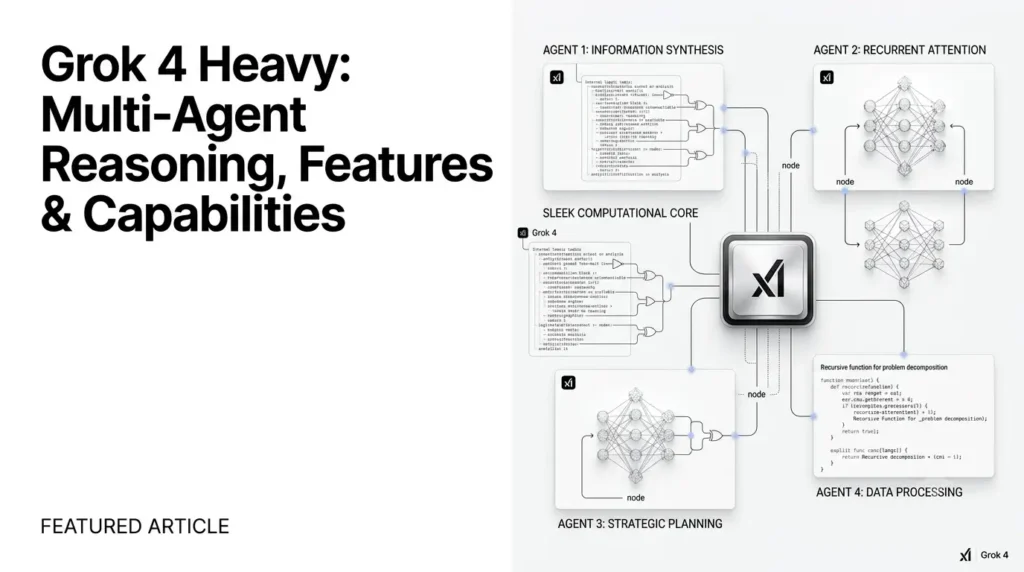
Grok 4 Heavy is xAI’s advanced, multi-agent reasoning system introduced on July 9, 2025.
Unlike standard Grok 4, which processes a task through its own reasoning process, Grok 4 Heavy uses parallel test-time computation to explore multiple hypotheses and improve the quality of its final answer. xAI designed it for difficult problems involving mathematics, science, coding, research, and complex reasoning.
The model attracted attention for its results on demanding academic benchmarks, including Humanity’s Last Exam and the 2025 USA Mathematical Olympiad.
However, Grok 4 Heavy is also a product of an earlier stage in xAI’s model development. Newer models, including Grok 4.5 and Grok 4.7, have since expanded the Grok family’s capabilities.
What Is Grok 4 Heavy?
Grok 4 Heavy is a high-compute version of xAI’s Grok 4 reasoning model that uses parallel test-time computation to evaluate multiple possible approaches to a problem.
Rather than relying on just one reasoning path, it can explore different hypotheses and use their results to produce a stronger answer.
xAI announced Grok 4 Heavy alongside Grok 4 on July 9, 2025, positioning it as the most powerful version of Grok 4 at launch. The company highlighted its performance on challenging academic and reasoning evaluations.
The central idea is that some difficult problems benefit from more than one attempt. A mathematical proof, for example, might have several possible approaches.
Exploring these approaches in parallel can help a system identify mistakes, compare solutions, and select a more convincing result.
Grok 4 Heavy is therefore best understood as a reasoning configuration built around additional computation, rather than an entirely unrelated model family.
How Does Grok 4 Heavy’s Multi-Agent Reasoning Work?
Grok 4 Heavy’s defining feature is parallel test-time compute.
This technique allocates additional computation to a problem after the model receives a prompt.
xAI describes the approach as allowing Grok to consider multiple hypotheses at once. Its launch presentation also depicts several agents working on the same task.
A simplified view of the process looks like this:
- Receive the problem: The system interprets the question, task, or set of constraints.
- Explore different approaches: Multiple reasoning paths or agents work on possible solutions in parallel.
- Evaluate the results: The system can use the candidate outputs to identify promising approaches and potential weaknesses.
- Produce a final answer: The process combines or selects useful results to generate a response.
This is a conceptual explanation of the approach, not a complete description of xAI’s proprietary implementation.
The exact coordination mechanism, number of agents used for every request, and internal selection algorithm are not fully specified in the public launch announcement.
Why use multiple agents instead of one?
A single reasoning process can overlook an assumption or become committed to an incorrect approach. Parallel reasoning creates opportunities to explore alternatives.
For example, imagine asking Grok 4 Heavy to evaluate a complicated mathematical proof. Different reasoning paths could attempt a direct proof, search for a counterexample, or verify intermediate steps. Comparing their results may expose an error that one approach would miss.
The same principle can help with technical research, where different approaches can investigate evidence, compare interpretations, and check whether a conclusion follows from the available information.
However, multiple agents do not automatically guarantee correctness. If the system’s reasoning paths share the same mistaken assumption, they may reach the same incorrect conclusion.
What Are the Main Features of Grok 4 Heavy?
Grok 4 Heavy combines Grok 4’s reasoning and tool-use capabilities with additional computation for difficult tasks.
1. Parallel reasoning
Parallel reasoning is the model’s main differentiator. Instead of relying exclusively on one line of reasoning, it can consider multiple hypotheses when tackling a challenging problem.
This is especially relevant to tasks that require several stages of analysis, such as mathematical proofs, scientific questions, and complex technical investigations.
2. Advanced mathematics and scientific problem-solving
xAI emphasized Grok 4 Heavy’s performance on mathematics and science benchmarks at launch.
These tasks require more than recalling information.
They may involve deriving results, testing assumptions, applying formulas, and connecting several concepts.
Potential uses include:
- Exploring alternative approaches to a mathematical problem.
- Checking intermediate steps in a technical derivation.
- Understanding complex scientific concepts.
- Investigating competing explanations for a research question.
- Reviewing a proposed solution for logical gaps.
The model can assist with these activities, but its answers still need verification, especially when calculations or scientific conclusions are consequential.
3. Coding and technical analysis
Grok 4 was trained to use tools, including code interpretation and web browsing.
Its reasoning capabilities can support programming and technical research, while the additional parallel computation in Grok 4 Heavy is intended to improve performance on demanding problems.
Developers could use a reasoning model for tasks such as understanding an algorithm, investigating a difficult bug, evaluating implementation options, or examining a complex technical design.
It is important to distinguish reasoning capability from software execution, however. A model’s ability to explain or generate code does not prove that the code works. Running tests and reviewing the output remain necessary.
4. Tool-assisted research
The original Grok 4 announcement describes native tool use and integration with web and X search. Grok 4 can select search queries and gather information to support difficult research questions.
Tool-assisted research can help when an answer depends on information beyond the model’s internal knowledge.
A researcher, for example, might ask it to investigate a technical subject, compare sources, and organize the findings into a structured explanation.
Search results still need to be assessed for relevance, credibility, and date. More computation does not eliminate unreliable sources or guarantee that the final answer accurately represents the evidence.
5. Additional computation for difficult tasks
Grok 4 Heavy was designed for situations where spending more computation on a problem could improve the result.
That makes it different from a system optimized primarily for quick responses. The objective is to improve the quality of difficult answers, not necessarily to return every answer as quickly as possible.
What do official test results show about Grok 4 Heavy’s performance?
Grok 4 Heavy received attention because of its reported performance on demanding academic evaluations.
The following results were highlighted by xAI in its July 2025 announcement.
| Benchmark | Reported Grok 4 Heavy result | What it evaluates |
|---|---|---|
| Humanity’s Last Exam | 50.7% | Difficult questions spanning expert-level academic subjects, on the reported text-only subset with tools |
| USAMO 2025 | 61.9% | Mathematical problem-solving and olympiad-level proofs |
Source: xAI’s official Grok 4 announcement.
These figures should be interpreted in the context of the evaluation setup. In particular, the Humanity’s Last Exam figure refers to the text-only subset with tools, not necessarily every version of the benchmark under identical conditions.
Benchmark results are useful for understanding a model’s demonstrated capabilities, but they do not predict success on every real-world task.
Performance can vary with the prompt, available tools, evaluation methodology, and problem type.
It is also important not to attribute every Grok 4 benchmark result to Grok 4 Heavy.
The standard Grok 4 model and its Heavy configuration are related, but their results and testing conditions are not interchangeable.
What is the difference between Grok 4 and Grok 4 Heavy?
The main difference is the amount and organization of computation used to solve a problem.
| Feature | Grok 4 | Grok 4 Heavy |
|---|---|---|
| Core relationship | Standard Grok 4 reasoning model | High-compute version of Grok 4 |
| Reasoning approach | Model-based reasoning with supported tool use | Parallel test-time computation across multiple hypotheses |
| Multiple reasoning paths | Not the defining feature of the standard offering | Central differentiator |
| Intended strength | General reasoning, research, coding, and tool-assisted tasks | Particularly demanding reasoning problems |
| Response speed | Depends on task and configuration | Additional computation can increase latency |
| Benchmark results | Must be evaluated separately | Reported strong results on selected difficult academic benchmarks |
| Launch date | July 9, 2025 | July 9, 2025 |
| API access | Grok 4 was offered through the xAI API at launch | A standalone public API model ID was not established in the launch announcement |
Grok 4 Heavy is not necessarily the better choice for every task.
A straightforward factual question, simple rewrite, or routine coding request may not benefit enough from additional reasoning to justify the extra processing time.
Its value lies in problems where exploring alternatives and checking complex reasoning can make a meaningful difference.
What is the difference between Grok 4 Heavy and newer Grok models?
Grok 4 Heavy belongs to an earlier stage of xAI’s model lineup. Since its launch, xAI has introduced additional models with different priorities.
For example, Grok 4.1 arrived in November 2025 with an emphasis on real-world usability and conversational quality.
Grok 4.5 followed in July 2026 with a focus on coding, agentic tasks, and knowledge work. The current xAI developer documentation also lists Grok 4.7.
| Model | Main emphasis | How it differs from Grok 4 Heavy |
|---|---|---|
| Grok 4 | General reasoning and tool use | The standard model on which Heavy was based |
| Grok 4 Heavy | Parallel reasoning for difficult tasks | Uses additional test-time computation to explore multiple hypotheses |
| Grok 4.1 | Conversational quality, helpfulness, and real-world usability | Focuses on improving everyday interactions rather than being defined by the Heavy configuration |
| Grok 4.5 | Coding, agentic tasks, and knowledge work | Targets newer software-engineering and knowledge-work demands |
| Grok 4.7 | Current-generation general-purpose and coding capabilities in xAI’s developer lineup | A newer model generation; it should not be treated as identical to the original Heavy configuration |
Sources: xAI’s Grok 4.1 announcement, Grok 4.5 announcement, and xAI developer model documentation.
These models should not be ranked solely by their names.
They target different tasks, and a meaningful comparison requires the same prompts, tools, evaluation conditions, and success criteria.
The distinction is particularly important for developers: the model available in the current API catalog may not expose the same user-facing experience as the original Grok 4 Heavy subscription feature.
What Can You Use Grok 4 Heavy For?
The multi-agent approach is most relevant to work that benefits from exploring and evaluating several possible solutions.
1. Mathematics and logical reasoning
Grok 4 Heavy can help explore difficult equations, analyze proof strategies, and investigate problems with multiple possible approaches. Users should still verify calculations and proof steps independently.
2. Scientific research
Researchers can use advanced reasoning models to organize questions, compare hypotheses, and identify gaps in an argument. When current evidence is required, source retrieval and verification remain essential.
3. Software engineering
Complex debugging, algorithm design, and architectural decisions may benefit from comparing alternative approaches. Generated code should be executed and tested before being used in production.
4. Technical and strategic analysis
A demanding analysis may require considering different assumptions, weighing trade-offs, and examining the implications of competing options. Parallel reasoning can be useful for generating and assessing alternatives, but the result should remain grounded in reliable evidence.
5. Learning and problem-solving
Students and professionals can use reasoning models to explore why a solution works, compare methods, and identify potential mistakes. The best learning workflow is to ask for the intermediate steps and then check them, rather than treating the final answer as automatically correct.
Is Grok 4 Heavy Free? Pricing and Availability
Grok 4 Heavy was introduced as part of xAI’s premium SuperGrok Heavy subscription tier in July 2025. It was not presented in the launch announcement as a standard, separately selectable API model in the same way as Grok 4.
Pricing and access need to be treated as time-sensitive information. Historical third-party coverage reported a launch-era price of approximately $300 per month for SuperGrok Heavy. That figure should not be assumed to represent the current subscription price or guarantee that the original Grok 4 Heavy experience is still available on the same terms.
As of October, 2026, xAI’s developer documentation lists newer Grok models, including Grok 4.7.
The original launch page remains useful for understanding Grok 4 Heavy’s design and historical benchmark claims, but it is not a complete guide to current subscription entitlements.
To check access today:
- Visit Grok and sign in.
- Review the subscription plans available to your account.
- Check the model picker or relevant product interface for the Heavy option.
- For API development, consult the official xAI model documentation and the model list available to your API key.
Do not assume that a current SuperGrok Heavy subscription, a newer Grok model, and the original Grok 4 Heavy configuration are interchangeable.
What Are the Limitations of Grok 4 Heavy?
Additional reasoning can improve the chances of finding a strong answer, but it does not remove the limitations of language models.
a) It can still produce incorrect answers
Multiple reasoning paths may agree on an incorrect conclusion.
Users should independently verify mathematical proofs, technical claims, citations, and important recommendations.
b) It may take longer to respond
Parallel computation requires additional resources. For routine questions, the extra processing may not produce enough improvement to justify the delay.
c) Benchmark results do not guarantee real-world success
Academic evaluations measure specific abilities under particular conditions.
Real projects may involve ambiguous requirements, incomplete data, changing constraints, or software environments that the benchmark does not capture.
d) Current information requires current sources
A model’s reasoning ability does not automatically make its information up to date.
Research involving current prices, regulations, software versions, or breaking news requires appropriate retrieval and source checks.
e) Availability can change
Grok 4 Heavy launched as a premium offering, and xAI’s model lineup has evolved since then. Its current availability, exact subscription terms, and access to any successor features should be checked directly with xAI.
Final Thoughts
Grok 4 Heavy introduced a distinctive approach to advanced AI reasoning: using additional computation to explore multiple hypotheses instead of relying on a single reasoning path.
Its reported results on Humanity’s Last Exam and USAMO 2025 helped demonstrate the potential of this approach for difficult mathematics, scientific questions, and complex analytical work.
Its main advantage is not that it must outperform every other Grok model on every task. It is that parallel reasoning can be valuable when a problem is difficult enough to justify the additional processing.
For readers evaluating Grok today, the historical distinction matters. Grok 4 Heavy explains an important step in xAI’s reasoning-model development, while newer models may be more relevant to current coding, research, and agentic workflows.
Check the current model catalog and subscription options before making decisions based on older specifications or pricing.
Frequently Asked Questions
1. What is Grok 4 Heavy?
Grok 4 Heavy is xAI’s high-compute version of Grok 4, announced in July 2025. It uses parallel test-time computation to explore multiple hypotheses and improve reasoning on difficult tasks.
2. How does Grok 4 Heavy’s multi-agent reasoning work?
It uses parallel computation to consider multiple possible approaches to a problem. The resulting candidates can be evaluated to produce a final response. The exact internal coordination process is proprietary and is not fully described in xAI’s public announcement.
3. Is Grok 4 Heavy better than standard Grok 4?
It was designed to improve performance on especially demanding reasoning tasks. That does not mean it is always faster or better for everyday questions. The best choice depends on task complexity, latency, and the quality required.
4. What benchmarks did Grok 4 Heavy achieve?
In its July 2025 announcement, xAI reported 50.7% on the text-only subset of Humanity’s Last Exam with tools and 61.9% on USAMO 2025. These are company-reported results tied to specific evaluation conditions.
5. Can developers access Grok 4 Heavy through the API?
The original launch announcement offered the standard Grok 4 model through the xAI API and introduced Heavy as a SuperGrok Heavy subscription feature. It did not establish a separate public API model ID for Grok 4 Heavy. Developers should check the current official model catalog for available models and features.
6. Is Grok 4 Heavy still available in 2026?
Its current availability under the original name and configuration should be verified in Grok’s subscription interface. xAI has since introduced newer models, including Grok 4.5 and Grok 4.7, so current access should not be inferred from the original 2025 announcement.
Also Read –
What Is Grok AI? Features, Use Cases, and How It Works?
Grok AI Features: Explore Everything Grok Can Do
SuperGrok Pricing and Plans: What Features Do You Get?
Grok 4.7 Explained: Features, Performance, Capabilities & What’s New