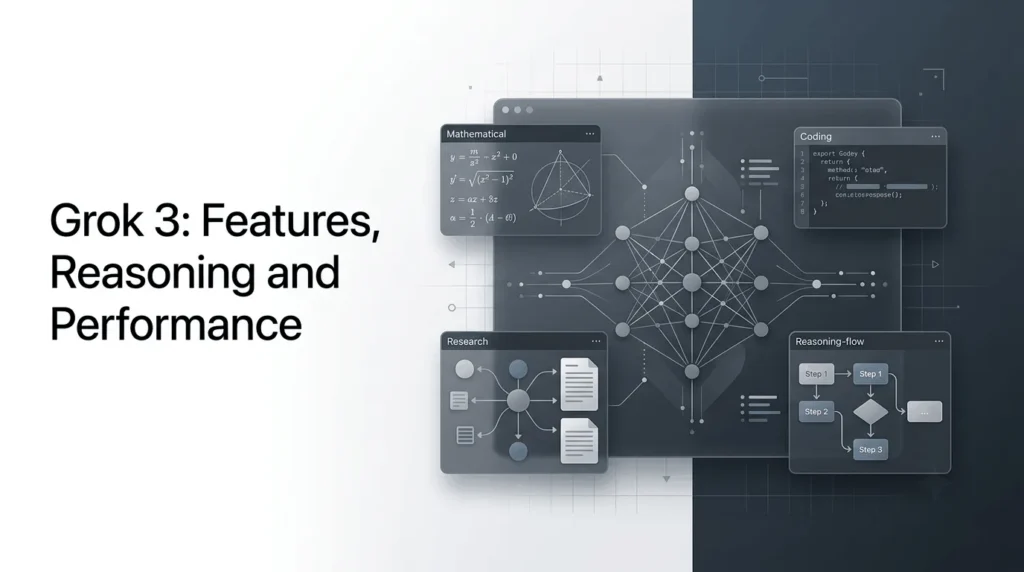
Grok 3 is an AI model developed by xAI and introduced in February 2025, with a focus on reasoning, mathematics, coding, scientific knowledge, and complex problem-solving.
Its launch also introduced Grok 3 Think, Grok 3 mini, and DeepSearch, expanding Grok beyond ordinary conversational responses.
However, Grok 3 is now an older generation. As of October 2026, xAI’s documentation identifies newer models, including Grok 4.7, and states that the original grok-3 API model was retired in May 2026.
Quick Summary
- Grok 3 is an AI model introduced by xAI in February 2025, designed for reasoning, mathematics, coding, and complex problem-solving.
- Key features include Grok 3 Think, Grok 3 mini, and DeepSearch.
- Grok 3 demonstrated strong results on several reasoning and coding benchmarks reported by xAI at launch.
- Clear prompts and relevant context can help users get better results for research, writing, and technical tasks.
- Grok 3 has limitations, including potential factual errors and the need to verify important information.
- The original Grok 3 API model was retired in May 2026, so availability may differ between the consumer app and API.
- Users exploring newer capabilities can consider Grok 4.7, while checking xAI’s official documentation for current model availability.
What Is Grok 3?
Grok 3 is a large language model built by xAI, the artificial intelligence company founded by Elon Musk. It was designed to combine extensive pretrained knowledge with improved reasoning capabilities, allowing it to tackle tasks that require more than a straightforward response.
Unlike a basic chatbot workflow, Grok 3’s reasoning mode could spend additional computation working through a problem, reconsidering approaches, and checking intermediate results before producing an answer.
At launch, xAI positioned it as a major improvement over Grok 2, particularly in mathematics, programming, scientific reasoning, and instruction following.
The company said it trained Grok 3 using its Colossus supercomputer cluster with ten times the compute used for its previous generation of models.
Grok 3 was initially released as a beta preview on February 19, 2025. Its launch marked an important step in xAI’s move toward reasoning-focused models and AI agents.
What are Key Features of Grok 3 ?
1. Advanced reasoning with Think mode
Grok 3 Think was designed for problems that benefit from additional reasoning rather than an immediate answer.
The model could spend seconds or longer evaluating possible approaches, revisiting earlier steps, and refining a solution. This was particularly relevant for mathematical problems, complex coding tasks, and multi-step questions.
For example, a user could ask it to solve an algebra problem, explain the assumptions behind a proposed solution, and identify where an incorrect calculation occurred.
More reasoning time can improve results, but it does not guarantee correctness. Users should independently verify important calculations, code, and factual claims.
2. Mathematics and scientific problem-solving
Mathematics and science were central to Grok 3’s launch positioning. xAI reported improvements on competition mathematics and graduate-level scientific question-answering benchmarks.
Potential uses included:
- Working through complex mathematical problems.
- Explaining scientific concepts.
- Analysing technical questions.
- Checking the logic of a proposed solution.
- Helping students understand problem-solving methods.
The distinction between generating an answer and verifying it remains important. A convincing explanation can still contain an incorrect assumption or calculation.
3. Coding and debugging
Grok 3 was designed to generate code, interpret programming instructions, and help users solve technical problems.
Developers could use it to draft functions, explain unfamiliar code, identify likely bugs, and explore alternative implementations. Its reasoning-focused mode was especially relevant when a task required multiple steps or careful consideration of edge cases.
For example, a developer could provide a function that fails under certain inputs and ask the model to identify the underlying issue, propose a correction, and create test cases.
Generated code should still be executed and tested in the intended environment. Model output alone is not proof that a program is secure, efficient, or correct.
4. DeepSearch for research
DeepSearch was introduced alongside Grok 3 as an agent designed to search for information, examine different sources, and produce a synthesised report.
Instead of answering a research question using only its pretrained knowledge, a search-enabled workflow could gather additional information and combine findings from multiple sources.
This made it useful for tasks such as researching a technology development, reviewing competing explanations, or investigating a question that requires current information.
Search results still need scrutiny. Sources can be incomplete, contradictory, or unreliable, and a summary may misinterpret the evidence it collects.
5. Long-context understanding
At launch, xAI stated that Grok 3 supported a context window of up to one million tokens. A context window determines how much input and conversation history a model can consider in a request.
A large context window can help with long documents, extensive instructions, and complex research tasks.
It does not mean every detail will always be recalled perfectly, nor does it guarantee that a model will reason accurately across an entire document.
The original launch specifications should not be assumed to apply unchanged to every current Grok interface or API model.
6. Image and video understanding
xAI also reported performance on multimodal benchmarks, including tests involving image understanding and video understanding.
These results indicated that Grok 3 was not limited to text-only tasks.
Actual capabilities depend on the particular model and product interface. Image input, video understanding, image generation, and video generation are distinct functions and should not be treated as interchangeable features.
How Does Grok 3 Reason?
Grok 3’s reasoning capabilities were developed using reinforcement learning, which can train a model to improve its problem-solving behaviour based on feedback or reward signals.
In simple terms, the model was trained not only to predict useful responses but also to improve how it approached certain difficult tasks. During inference, Think mode could allocate additional computation to a problem.
A simplified workflow looks like this:
- Understand the task: Identify the question, constraints, and required output.
- Explore possible approaches: Consider different ways to solve the problem.
- Evaluate the solution: Check intermediate steps and reconsider approaches where necessary.
- Produce a response: Return an answer based on the selected approach.
This is a simplified explanation, not a complete description of the model’s internal processes. The reasoning text presented to a user should not automatically be interpreted as a perfect record of every internal computation.
What is the benchmark performance of Grok 3?
xAI published benchmark results when it announced Grok 3 in February 2025. These figures provide a snapshot of the model’s reported performance at launch, rather than a current ranking of all available AI models.
| Benchmark | Grok 3 result reported by xAI | What it measures |
|---|---|---|
| AIME 2024 | 52.2% | Competition mathematics |
| GPQA | 75.4% | Graduate-level scientific reasoning |
| LiveCodeBench | 57.0% | Code generation and problem-solving |
| MMLU-Pro | 79.9% | Broad knowledge and reasoning |
| MMMU | 73.2% | Multimodal understanding |
| EgoSchema | 74.5% | Video understanding |
Source: xAI’s February 19, 2025, Grok 3 launch announcement
These figures are the company’s published results, and comparisons should account for benchmark versions, evaluation settings, inference-time computation, and the methods used by competing models.
How did Grok 3 Think perform?
xAI also reported results for Grok 3 Think using additional reasoning computation:
- AIME 2025: 93.3% with its reported
cons@64setting. - GPQA: 84.6%.
- LiveCodeBench: 79.4%.
AIME 2025 figure used a different test from AIME 2024 and a specific computation setting. It should not be compared directly with the standard Grok 3 AIME 2024 result as if both were measured under identical conditions.
Benchmark scores help evaluate specific capabilities, but they do not fully predict how useful a model will be for an individual’s work.
Real-world performance also depends on prompt quality, tools, context, and the difficulty of the task.
How does Grok 3 compare to Grok 3 Mini?
Grok 3 mini was introduced as a more cost-efficient reasoning model, particularly for tasks involving mathematics and other STEM problems.
| Feature | Grok 3 | Grok 3 mini |
|---|---|---|
| Main emphasis | Broad knowledge and reasoning | More cost-efficient reasoning |
| Mathematics | Designed for complex problems | Designed for efficient STEM problem-solving |
| Coding | Coding and debugging assistance | Coding and technical reasoning |
| World knowledge | Broad pretrained knowledge | xAI positioned it toward tasks needing less extensive world knowledge |
| Best fit | Complex tasks requiring broader knowledge | Tasks where reasoning efficiency is important |
The choice depends on the task, available access, and the trade-off between model capability and cost. These are descriptions of the original model family, not a statement that both models remain separately available in every current product.
How much better is Grok 3 than Grok 2?
Grok 3 represented a substantial step forward in xAI’s published reasoning ambitions compared with Grok 2.
| Area | Grok 2 | Grok 3 |
|---|---|---|
| Generation | Earlier model generation | Released as its successor in February 2025 |
| Reasoning focus | Earlier capabilities | Dedicated Think reasoning variants |
| Mathematics and science | Capabilities of the previous generation | Stronger results reported by xAI on selected benchmarks |
| Research workflow | Depended on available product tools | Launched alongside DeepSearch |
| Training scale | Earlier training infrastructure | xAI reported ten times the compute of its previous generation |
This comparison reflects xAI’s launch positioning and the features announced at the time. It should not be interpreted as an independent assessment of every task or use case.
Is Grok 3 Still Available in 2026?
Grok 3’s current availability needs an important distinction between the consumer app and the developer API.
In its model-retirement documentation, xAI states that the grok-3 API model was retired on May 15, 2026.
Requests to that model identifier are redirected to Grok 4.3 with no reasoning effort. As a result, a developer using the old identifier should not assume the API is still serving the original Grok 3 model.
The consumer Grok interface can have a different model-selection and rollout policy. The availability of the original model in the app should be checked directly rather than inferred from API behaviour.
As of October 2026, xAI’s model documentation lists Grok 4.7 as its recommended model for general chat and coding tasks. For current access, developers should consult the official xAI model documentation, while consumers can check the official Grok website.
Is Grok 3 Free?
Grok access and API usage are governed by different pricing arrangements.
For consumer access, xAI offers a free tier alongside paid subscriptions with different limits and capabilities. The model available to a user can depend on the current product interface and subscription.
For API access, billing is based on the models and tools used. Because the original Grok 3 API model has been retired and its identifier redirects to a newer model, developers should check current pricing before estimating costs.
See the official xAI pricing page for consumer plans and the API pricing documentation for developer usage. Prices and entitlements can change.
How to Get Better Results From Grok 3?
To get better results from Grok 3, write specific prompts, provide relevant context, and break complex tasks into smaller steps.
For coding or mathematics, ask it to explain its approach and verify the final answer.
As a content creator, I find that clear instructions and examples make AI-generated drafts easier to refine.
Who Should Use Grok 3?
Grok 3 may interest students, developers, researchers, and content creators who want help with mathematical problems, coding, technical explanations, and multi-step reasoning.
However, it is an older model generation, so users choosing an AI assistant today should compare currently available models and check whether Grok 3 is accessible in their preferred interface.
Can You Get Better Results From Grok 3?
Yes, prompt quality can make a difference. Describe your goal clearly, include relevant background, and specify any constraints or output format.
For difficult tasks, ask Grok to explain its approach and check the result yourself.
Better prompts can improve usefulness, but they cannot eliminate factual errors or guarantee a correct answer.
How Can I Get Access to Grok 3?
Start by checking the official Grok website for available models and access options.
Keep in mind that xAI retired the original Grok 3 API model on May 15, 2026, so developers should consult the official model documentation before integrating it.
Availability in the consumer app may differ from API access.
What are the Limitations of Grok 3 ?
Despite its reasoning improvements, Grok 3 has limitations that users should understand.
- Hallucinations: It can produce incorrect facts, calculations, citations, or explanations.
- Benchmark limitations: Strong results on selected tests do not establish superiority on every task.
- Reasoning cost and latency: More extensive reasoning can take longer and use additional computation.
- Outdated information: Current facts require a suitable search or retrieval workflow.
- Code reliability: Generated code needs testing, review, and security checks.
- Changing availability: Grok 3’s original API model has been retired, so access and behaviour may differ from its 2025 launch.
For research, technical work, and business decisions, treat AI output as assistance rather than a substitute for verification.
My Experience Using Grok 3 as a Content Creator
As a content creator, I see Grok as more than a tool for generating text. It can help me brainstorm article ideas, organise research, develop outlines, and refine early drafts.
For more demanding tasks, I would consider a newer model such as Grok 4.7 rather than relying on the older Grok 3.
My preferred approach is to give the model a clear brief, review its suggestions, and verify important facts before publishing.
This keeps the workflow efficient without sacrificing accuracy or editorial judgment.
Final Thoughts
Grok 3 was an important milestone for xAI because it brought reasoning-focused variants, stronger reported mathematics and coding results, and DeepSearch into the Grok ecosystem.
Its launch helped establish the direction of xAI’s subsequent reasoning and agent capabilities.
However, Grok 3 is no longer the latest generation, and its original API model has been retired.
Readers looking to use Grok today should check the current product interface, model documentation, and pricing rather than assuming that launch-era features and access arrangements remain unchanged.
Frequently Asked Questions
1. What is Grok 3 used for?
Grok 3 was designed for conversational assistance, mathematics, coding, scientific questions, and multi-step reasoning. Its launch also introduced Think reasoning modes and DeepSearch for research-oriented tasks.
2. When was Grok 3 released?
xAI announced the Grok 3 beta on February 19, 2025.
3. What is the difference between Grok 3 and Grok 3 Think?
Grok 3 was the general model, while Grok 3 Think was a reasoning-focused variant that could use additional computation to work through difficult problems.
4. Was Grok 3 better than ChatGPT?
There is no universal answer. xAI published strong results for Grok 3 on selected benchmarks, but comparisons depend on the ChatGPT model, test conditions, tools, and task. A launch benchmark alone cannot establish which assistant is best overall.
5. Can developers still use the Grok 3 API?
The original grok-3 API model was retired on May 15, 2026. According to xAI’s documentation, requests using its old identifier redirect to Grok 4.3 with no reasoning effort. Developers should consult current model documentation before building new integrations.
6. Is Grok 3 the latest Grok model?
No. As of October 2026, xAI’s documentation lists newer models, including Grok 4.7. Grok 3 is best understood as an earlier generation in the Grok model family.
Also Read –
What Is Grok AI? Features, Use Cases, and How It Works?
Grok AI Features: Explore Everything Grok Can Do
Grok Safety and Moderation: Safety, Moderation, and Policy Changes Affecting Users
Pingback: Grok 3 Mini: Features, Benchmarks and Everything You Need to Know