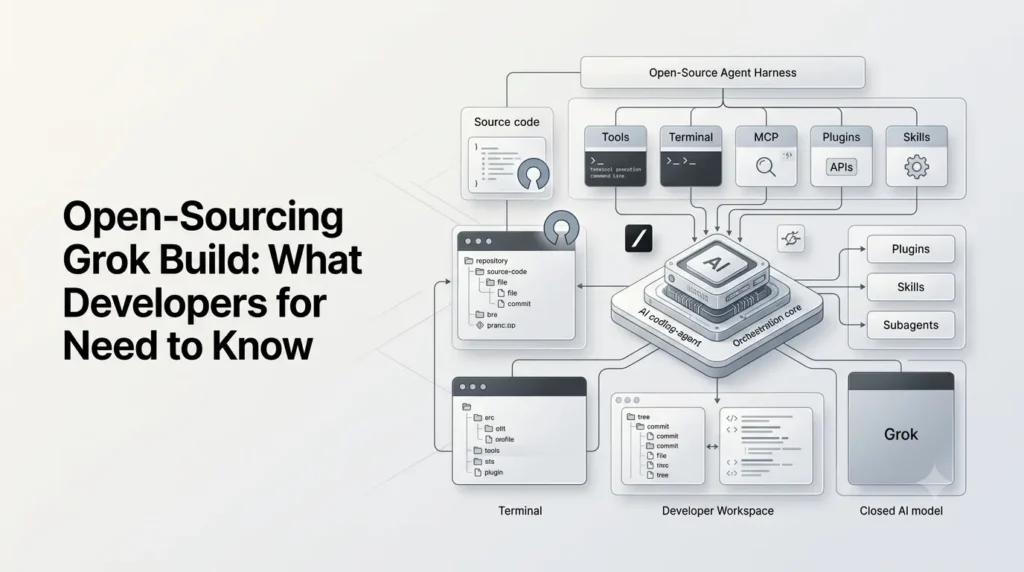
xAI open-sourced Grok Build, the coding-agent harness and terminal user interface behind its AI coding workflow, on July 15, 2026. The source is available through the official xai-org/grok-build repository under the Apache License 2.0.
For developers, the significance is less about getting an open-source version of the Grok model itself and more about gaining access to the agent runtime that connects a model to code, tools, files, terminals, skills, plugins, MCP servers, and subagents.
That distinction matters. xAI has exposed the software layer responsible for orchestrating coding-agent behavior, while the underlying Grok models remain separate products accessed through Grok or the xAI API.
What Is Grok Build?
Grok Build is xAI’s coding-agent environment designed to work directly with software projects. Its terminal application can understand a codebase, edit files, execute commands, search the web, and handle longer-running development tasks. The open-source repository contains the Rust implementation of the Grok CLI/TUI and its agent runtime.
The public code includes several important components:
- Agent runtime and execution loop
- Context assembly
- Model-response parsing
- Tool-call dispatch
- File reading and editing
- Terminal command execution
- Search capabilities
- Interactive terminal UI
- Planning and plan approval
- Inline diff viewing
- Skills
- Plugins
- Hooks
- MCP server support
- Subagents
- Workspace and checkpoint functionality
xAI says the source is intended to make the harness easier to inspect, extend, and understand. Developers can examine how context is assembled and how tools are invoked rather than treating the agent as a completely opaque application.
What Exactly Did xAI Open-Source?
The most important clarification is that Grok Build is not the same thing as open-sourcing Grok.
xAI open-sourced the coding-agent harness and terminal UI. The repository contains the Rust source for the grok CLI/TUI and its agent runtime.
The release includes:
| Component | Open-sourced? |
|---|---|
| Grok Build CLI/TUI | Yes |
| Agent runtime | Yes |
| Tool implementations | Yes |
| Terminal UI | Yes |
| Skills/plugins/hooks integration | Yes |
| MCP server integration | Yes |
| Subagent infrastructure | Yes |
| Grok model weights | No |
| Grok model training code | Not part of this release |
| Hosted Grok Build service | Not simply released as a self-contained open-source clone |
This distinction prevents a common misconception: developers can inspect and build around the Grok Build harness, but the release does not provide the weights for the underlying Grok models.
Why Is Grok Build Open Source?
xAI’s stated reason is transparency and extensibility.
The company says publishing the source provides a direct way to build toward a more robust and reliable coding-agent harness. Developers can inspect how the system assembles context, parses responses, and dispatches tool calls.
There is also a practical ecosystem argument.
Modern coding agents are not simply language models. They are systems that combine:
Model + context + tools + execution + state + permissions + interfaces
Making the harness visible gives developers a reference implementation for putting those pieces together.
That can be useful even when developers use a different model.
How Does the Open-Source Grok Build Architecture Work?
The repository is organized into multiple Rust crates covering different parts of the agent system.
The official README identifies components for the terminal UI, agent runtime, tools, workspace handling, configuration, MCP, and related infrastructure.
At a simplified level, the workflow looks like this:
User request → Context assembly → Model → Tool call → Tool execution → Result → Updated context → Next model action
For a coding task, that could mean:
- The developer gives the agent a task.
- Grok Build reads relevant project information.
- The model determines what action is required.
- The agent invokes a tool.
- The tool reads or modifies files, runs commands, or performs another supported operation.
- The result is returned to the agent.
- The context is updated.
- The model decides what to do next.
- The process continues until the task reaches an appropriate stopping point.
The important part is the orchestration layer between the model and the developer’s environment.
What Can Developers Learn From the Source?
One of the most useful aspects of the release is that developers can study an actual production-oriented agent harness rather than designing every component from scratch.
1. Context assembly
Agent performance depends heavily on deciding what information should be sent to the model.
The Grok Build source provides developers with a concrete implementation to study for context assembly and tool interaction. xAI specifically highlighted this as one reason for publishing the code.
This can help developers investigate questions such as:
- What project information should enter the context?
- When should tool results be retained?
- How should an agent manage longer tasks?
- How should previous actions influence the next step?
- How can unnecessary context be avoided?
2. Tool calling
A coding agent becomes useful when it can actually interact with its environment.
Grok Build’s published tools include functionality for working with files, executing commands, searching, and interacting with the development environment.
Developers can therefore study how a model’s textual output becomes an executable tool action.
3. Agent extensibility
Grok Build supports skills, plugins, hooks, MCP servers, and subagents. xAI specifically highlighted these extension points in its open-source announcement.
This is particularly relevant to developers building specialized agents.
Instead of creating one enormous agent with every capability embedded inside it, developers can separate capabilities into modular components.
Can Grok Build Run Locally?
Yes, with an important qualification.
xAI says Grok Build can run local-first: developers can compile the software themselves, configure it through config.toml, and point it at local inference.
The official repository also provides instructions for building the project from source using Rust and the pinned toolchain.
This creates an important architectural possibility:
Open-source harness + locally available model = locally operated coding-agent stack
However, local execution of the harness should not be confused with local execution of proprietary Grok models. The availability of a suitable local inference model depends on the model and configuration being used.
Does Open-Sourcing Grok Build Mean Grok Is Fully Local?
No.
The open-source release makes the agent software available. It does not automatically make proprietary Grok models available for local inference.
This distinction is especially important for developers evaluating privacy and infrastructure requirements.
A locally compiled agent can still communicate with a remote model API depending on its configuration.
Developers should therefore evaluate separately:
- Where the agent runtime executes
- Where model inference executes
- Where source code is processed
- Where tool commands execute
- Where logs and state are stored
- Which external services receive project data
What License Does Grok Build Use?
The first-party code in the repository is licensed under the Apache License 2.0. The repository also contains third-party and vendored components with their own licensing notices.
The Apache 2.0 license is permissive and allows developers to use, modify, and redistribute covered code subject to its license conditions.
However, developers should not assume that every file or dependency in the repository has identical licensing terms.
The repository specifically directs users to its third-party notices for bundled and vendored components.
Can Developers Contribute Code to Grok Build?
This is one of the biggest differences between source-available transparency and a conventional community-driven open-source project.
The repository currently states that external contributions are not accepted. xAI develops the software internally and publishes the source for transparency and local builds.
That means developers can:
- Read the implementation
- Build the software
- Modify their own copy
- Experiment with the architecture
- Integrate it into their workflows subject to the license
But they should not assume they can submit pull requests and have them merged into xAI’s official development process.
This makes the project better described as an open-source release with an internally controlled upstream, rather than a conventional community-maintained project.
How Does Grok Build Compare With Other Coding Agents?
Grok Build sits within a broader category of terminal-based and agentic coding systems.
Its distinctive characteristic is that xAI has released the underlying harness source rather than exposing only a closed application.
| Capability | Grok Build | Conventional closed coding agent |
|---|---|---|
| Terminal coding workflow | Yes | Often |
| File editing | Yes | Often |
| Agentic tool use | Yes | Often |
| MCP support | Yes | Varies |
| Skills/plugins | Yes | Varies |
| Source code available | Yes | Usually no |
| Local compilation | Yes | Varies |
| Apache 2.0 first-party code | Yes | Varies |
| External contributions | Not accepted | Depends on project |
The comparison should not be interpreted as a performance ranking. Coding-agent quality depends on the model, harness, tools, context strategy, permissions, and task.
What Does This Mean for AI Agent Developers?
The open-source Grok Build release is particularly relevant to developers building agent infrastructure, rather than only developers looking for another coding assistant.
A coding agent needs several systems working together:
- Model inference
- Context management
- Tool execution
- File-system access
- Shell execution
- Planning
- State management
- Extension mechanisms
- Security controls
- Human approval
- Error recovery
Grok Build exposes many of these layers.
That makes the repository potentially useful as a reference architecture for developers designing their own agents.
What Does It Mean for MCP Developers?
MCP, or the Model Context Protocol, has become an important mechanism for connecting agents with external tools and data.
Grok Build supports MCP servers, alongside skills, plugins, hooks, and subagents.
For MCP developers, the release provides another implementation to study when thinking about:
- Server discovery
- Tool invocation
- Context integration
- Permission boundaries
- Agent-to-tool communication
- Long-running workflows
This does not mean every MCP implementation will behave identically. Developers still need to inspect the actual interfaces and documentation for the version they use.
What About the Grok Build Model?
Grok Build is also associated with a dedicated coding model.
In May 2026, xAI released grok-build-0.1 through the xAI API in public beta. xAI described it as a coding model trained for agentic coding tasks including web development, debugging, and MCP support. The company also said it was the model powering Grok Build at that time.
xAI listed pricing at launch of:
- $1 per million input tokens
- $2 per million output tokens
The model was designed to work particularly well inside agentic coding harnesses and was also made available through third-party platforms including OpenRouter and Vercel AI Gateway.
The important architectural point is that the model and the harness are separate layers.
Grok Build’s open-source harness can therefore be understood independently from the particular model powering it at any given point.
Grok Build Has Also Expanded Beyond the Terminal
The open-source terminal release came after Grok Build had already expanded into other parts of the Grok product.
xAI initially introduced Grok Build as an early-beta terminal coding agent in May 2026.
It later introduced Build Mode for creating websites, apps, games, and interactive dashboards directly through Grok’s web and mobile interfaces.
By August 19, xAI said Grok Build was available across its plans on web and mobile. The service added features including publishing, Remix, custom domains, GitHub export, secrets, connectors, and access to xAI APIs for applications built through the platform.
These should not be confused with the open-source repository.
The repository primarily represents the coding-agent CLI/TUI and its runtime, while Build Mode is a hosted product experience.
What Are the Practical Use Cases for Developers?
The open-source Grok Build code can be useful in several scenarios.
1. Building a custom coding agent
Developers can use the architecture as a reference when creating their own agent.
For example, a team could study how the runtime separates:
- Agent logic
- Tools
- Workspace handling
- UI
- Configuration
- MCP
- Skills
2. Running customized development workflows
Teams can modify their local copy to suit particular engineering environments.
Potential applications include:
- Internal coding assistants
- Repository maintenance
- CI/CD automation
- Code migration
- Debugging workflows
- Documentation generation
- Automated testing
- Developer operations
The actual suitability depends on the project’s security model and the modifications made.
3. Studying agent architecture
Researchers and developers can inspect a real implementation rather than relying entirely on theoretical agent diagrams.
This can be valuable for understanding the engineering trade-offs behind tool-using AI systems.
What Are the Security Considerations?
An agent that can read files and execute shell commands has considerably more authority than a conventional chatbot.
Grok Build’s capabilities therefore make security an important part of any deployment.
Developers should carefully consider:
- File-system permissions
- Shell-command permissions
- API credentials
- Environment variables
- MCP server trust
- Third-party plugins
- Secrets handling
- Network access
- Repository isolation
- Logs and stored context
- Human approval for destructive actions
The official repository also provides a security policy and asks users to report vulnerabilities through the appropriate security process rather than publicly opening an issue.
A locally compiled agent should not automatically be granted unrestricted access to production systems.
What Are the Limitations of Open-Sourcing Grok Build?
Open source does not remove every limitation.
The model remains a separate dependency
Publishing the harness does not provide the proprietary Grok model weights.
External contributions are restricted
The repository currently does not accept external pull requests.
The project can change quickly
Grok Build is an actively developed system. The repository is periodically synchronized from xAI’s internal monorepo, and a SOURCE_REV file identifies the corresponding source revision.
Dependencies have separate licenses
Developers distributing modified versions need to examine third-party and vendored components rather than assuming the Apache 2.0 license covers everything identically.
Local deployment requires engineering work
Compiling the harness is only one part of operating an agent. Developers still need to configure models, credentials, tools, permissions, and infrastructure appropriate to their environment.
Why Does Open-Sourcing Grok Build Matter for the AI Developer Ecosystem?
The release shifts some attention away from the model itself and toward the agent harness.
As AI coding systems become more capable, the model is only one component of the product. The surrounding software determines how the model interacts with files, tools, terminals, memory, external services, and human approvals.
By publishing Grok Build, xAI gives developers a concrete implementation of those orchestration mechanisms.
It also makes the architecture easier to inspect and reproduce at the software layer.
The broader implication is therefore not simply that developers now have another coding CLI. It is that an increasingly important part of AI development—the agent runtime surrounding the model—is becoming something developers can examine and customize.
Conclusion
The open-sourcing of Grok Build gives developers access to the software architecture behind xAI’s coding-agent workflow rather than opening the underlying Grok model itself.
The release exposes the agent runtime, terminal interface, tools, workspace components, and extension mechanisms under an Apache 2.0 license, while keeping external contributions closed and the proprietary model layer separate.
For developers, the most useful aspect may be the opportunity to study how a modern coding agent assembles context, invokes tools, manages projects, and connects models with real development environments. The result is a useful reference point for the next generation of AI agent and coding-agent infrastructure.
Frequently Asked Questions
1. Is Grok Build open source?
Yes. xAI released the source for Grok Build’s coding-agent harness and terminal UI on July 15, 2026. The first-party source is licensed under Apache 2.0.
2. Is the Grok AI model open source?
No. Open-sourcing Grok Build does not mean that xAI has released the weights of its proprietary Grok models. The release concerns the coding-agent harness and TUI.
3. Can I run Grok Build locally?
Yes. xAI says Grok Build can run local-first, and the repository provides instructions for compiling it from source. Local execution of the harness does not automatically mean that proprietary Grok model inference runs locally.
4. Can developers contribute to the Grok Build repository?
Currently, no. The repository’s contribution policy states that external pull requests and unsolicited patches are not accepted.
5. What language is Grok Build written in?
The published Grok Build repository is primarily a Rust codebase.
6. What does Grok Build actually include?
The repository includes the agent runtime, terminal UI, tool implementations, workspace functionality, and extension mechanisms such as skills, plugins, hooks, MCP servers, and subagents.
Also Read –
xAI Grok Build: Multi-Agent AI Coding Explained
Grok AI Features: Explore Everything Grok Can Do
Grok Safety and Moderation: Safety, Moderation, and Policy Changes Affecting Users