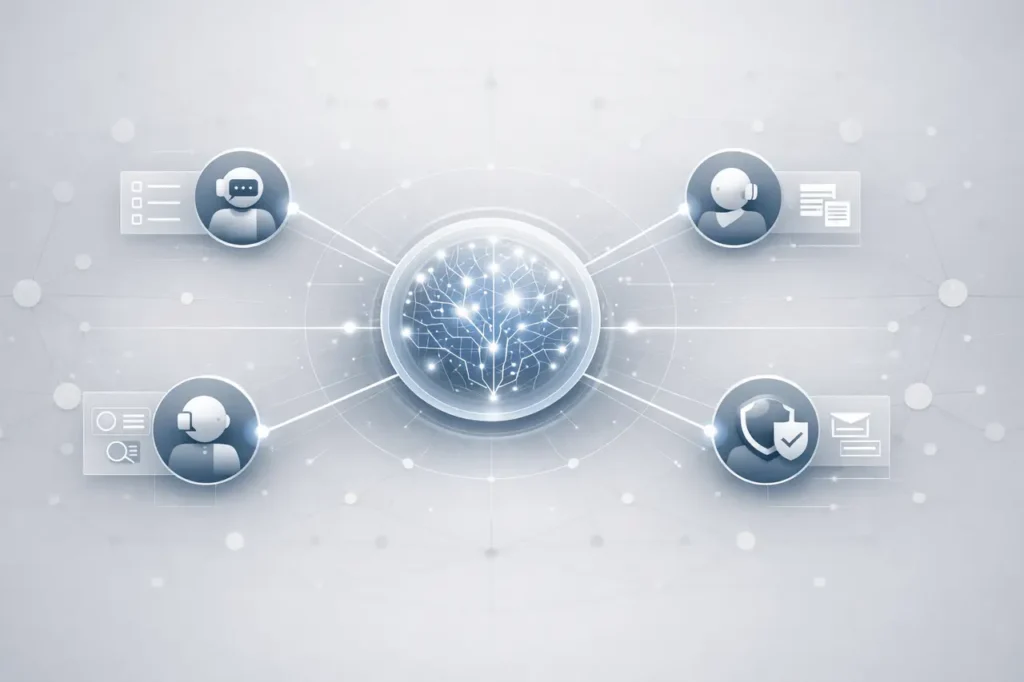
Artificial intelligence is swiftly moving from single-model systems to collaborative AI systems that can complete complex tasks with others. The individual AI agent team Grok introduces a fresh approach that enables multiple AI agents to work simultaneously, each with its own tasks such as analysis, reasoning, and verification.
In version 4.20 beta, Grok users can use a native multi-agent framework directly from Grok’s platform. Instead of relying solely on a single agent, the system lets multiple AI agents collaborate in parallel, debating answers, cross-checking data, and improving outputs before providing results.
This architecture reflects an overall shift towards AI agents working together, in which integrated AI units enhance accuracy, depth of reasoning, and efficiency for more complex workflows.
What is the Personal AI Agent Team doing on Grok?
Grok’s personal AI team is a multi-agent artificial Intelligence system that allows users to use various AI agents with specific capabilities in a single environment.
Instead of generating responses with individual AI models, Grok’s design enables multiple agents to collaborate on a project. Each agent has an individual role, like:
- Information retrieval and research
- Analytical reasoning, logic and logical thinking
- Checking facts and verifying
- Output refinement and summarisation
This design helps reduce common AI problems, such as hallucinations and insufficient reasoning, by introducing internal checks between agents.
Key Characteristics
- Multiple agents working simultaneously
- Independent reasoning processes
- Cross-verification between agents
- Parallel task execution
- Customizable agent roles
By combining these features and capabilities, the system creates a tiny AI “team” that acts on behalf of users.
Grok 4.20 Beta: Core Multi-Agent Architecture
Grok 4.20 Beta is an in-built multi-agent platform specifically designed to handle more advanced workflows.
Two primary configurations are offered based on the plan of use.
Multi-Agent Configuration Overview
| Feature | Standard Multi-Agent Mode | Heavy Multi-Agent Mode |
|---|---|---|
| Number of Agents | 4 agents | Up to 16 agents |
| Workflow Type | Parallel collaboration | Large-scale AI swarm |
| Task Complexity | Moderate to advanced | Highly complex tasks |
| Verification Layer | Built-in agent debate | Extensive cross-checking |
| Customization | Individual agent tuning | Advanced orchestration |
The 4-agent system is the default configuration for collaborative work, and the 16-agent swarm enables more extensive analysis and reasoning across a variety of AI processes.
How does the Grok AI Agent Team work?
The AI team, based on Grok, can operate using parallel reasoning. Instead of processing a question sequentially, agents can analyse the problem at a time.
Step-by-Step Workflow
1. Task Assignment
When a user makes a request, the system distributes a portion of the task to multiple agents.
Each agent can focus on various aspects, including reasoning, research, or summarisation.
2. Independent Analysis
Agents address the problem in their own way. This allows for multiple possible solutions and interpretations to be developed simultaneously.
3. Internal Debate
Agents can compare responses and confront inconsistencies. This kind of reasoning in a debate helps to identify weak or incorrect conclusions.
4. Fact-Checking Layer
Certain agents could focus solely on verifying the outputs created by other agents.
5. Final Output
After internal validation and the fusion of results to produce a refined response.
This structure creates redundancy and verification. This may increase the reliability of the output.
Customisation Options for AI Agents
One of the prominent features of Grok’s individual AI agents is the ability to customise them.
Users can set up individual agents with distinct behaviour and duties.
Possible Custom Agent Roles
- Research Agent – gathers relevant information
- Logic Agent – evaluates reasoning paths
- Fact-Check Agent – validates accuracy
- Critic Agent – identifies weak arguments
- Summarizer Agent – compiles final results
Since each agent operates independently, this system can benefit from diverse viewpoints, similar to collaborative human teams.
Advantages of a Multi-Agent Artificial System
The transition from single-agent to multi-agent AI assistance systems offers a range of advantages.
1. Higher Reliability
If multiple agents look at an identical issue, wrong results are likely to be identified and rectified.
2. Parallel Processing
Tasks can be handled concurrently rather than sequentially, increasing effectiveness for more complex issues.
3. Better Reasoning
The internal debate between agents can help refine the logical conclusion.
4. Flexible Workflows
Users can customise agents for various tasks, such as research, coding, and data processing.
5. Reduced Risk of AI Hallucination
Cross-checking between agents adds a layer of verification.
Possible Limitations as well as Problems
Despite their benefits, multi-agent systems can also pose challenges.
Complexity
Managing multiple AI agents requires additional computational resources and an orchestrator.
Output Coordination
When multiple agents generate results simultaneously, synthesising them into a coherent solution can be difficult.
Resource Usage
Agent swarms with a large number of agents, such as the 16-agent configuration, need significantly more processing power.
Prompt Design
Users might need to organise prompts more precisely to ensure agents cooperate effectively.
Use Cases to build an Individual AI Agent Team
The Personal AI Agent Team using Grok can assist with a variety of technical and professional workflows.
Research and Knowledge Work
Multiple agents can gather, analyse, and validate information simultaneously.
Software Development
Agents collaborate on debugging, architectural analysis and documentation.
Data Analysis
Separate agents can evaluate datasets, detect patterns, and validate statistical conclusions.
Content Production
Agents can generate drafts, analyse the structure, and refine the final product.
Strategic Decision Support
Teams of AI agents can explore multiple thought paths before making suggestions.
Single AI Assistant vs Multi-Agent AI
| Aspect | Single AI Assistant | Multi-Agent AI System |
|---|---|---|
| Processing Style | Sequential reasoning | Parallel reasoning |
| Verification | Limited self-checking | Cross-agent validation |
| Task Complexity | Moderate | High complexity |
| Accuracy Potential | Variable | Potentially improved |
| Workflow Flexibility | Limited | Highly customizable |
This is a good example of why Multi-agent Collaboration is becoming more popular in current AI development.
Why Multi-Agent AI is a Trending Topic?
AI research is now focusing on cooperative intelligence. This is where various AI systems cooperate to tackle issues.
This method is similar to real-world human teams where several specialists share their knowledge.
The most important trends driving this change include:
- Growth of autonomous AI agents
- Demand for complicated job automation
- The need to be able to provide greater accuracy to AI decision-making
- Development of AI orchestration frameworks
The personal AI agent team at Grok is one of the ways these new trends are being incorporated into the real-world of AI instruments.
My Final Thoughts
The AI team personnel on Grok is an evolution of the technique for artificial intelligence that lets several agents work together to accomplish tasks better than a single assistant.
With the release of Grok 4.20 Beta, users can use a built-in multi-agent platform that supports parallel reasoning, internal debate, and cross-verification. It is compatible with the collaborative mode for four agents and the larger 16-agent swarm configuration, which enables more sophisticated workflows.
As AI advances towards self-governing and collaborative systems, multi-agent platforms will likely be an essential model for future AI platforms. These systems are designed to improve the quality of reasoning, increase accuracy, and expand the scope of tasks AI can handle effectively.
FAQs
1. What is Grok’s private AI agent team?
It is a multi-agent AI system in which multiple agents collaborate on tasks. Each agent has distinct tasks, including research and reasoning, as well as verification.
2. Which AI agent can Grok run at once?
The standard configuration has four agents, whereas advanced configurations can have at least 16 agents in parallel.
3. Why should you use several AI agents rather than just one?
Multiple agents can view issues from different perspectives, compare results, and improve overall precision.
4. Can users modify AI agents within Grok?
Yes. Agents can be configured to play different roles and exhibit behaviours, enabling users to design specific AI workflows.
5. What are the tasks that benefit the most from AI with multi-agents?
Complex workflows, such as study analysis, software development, and strategic planning, benefit most from AI collaboration technology.
6. Can a multi-agent system increase AI accuracy?
Although it cannot ensure perfect results, cross-verification of agents can reduce the risk of mistakes and improve the quality of responses.
Also Read –