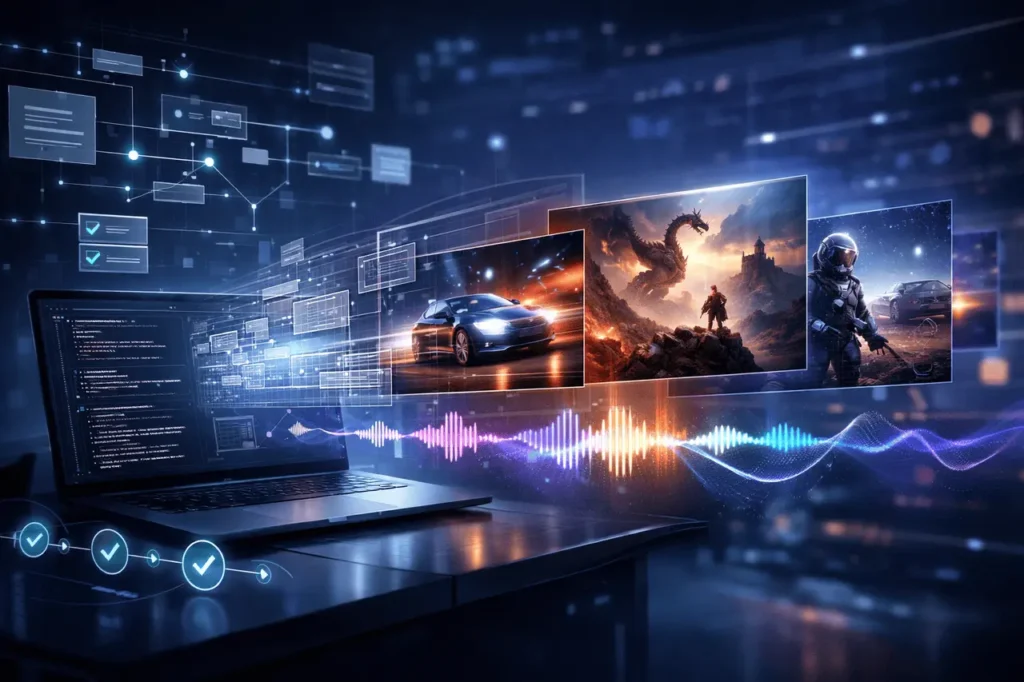
In the ever-changing world of artificial intelligence, Grok Imagine and Google MCP integrations are two significant developments that will affect how developers create multimedia content and connect AI systems to real-world data. In the same cycle of innovation, Google also rolled out an initial CI Fixer feature to its Jules SWE Agent, expanding the automated development assistance. This article explains the nature of these technologies, how they work, where they are most important, and what developers need to consider when implementing them.
What is Grok Think?
Grok Imagine is an artificial intelligence-driven video and image generation system that enables creators and developers to create visual content using images or text prompts. The technology was initially part of the Grok AI product family. Grok Imagine is now accessible via a video API geared towards speed, interoperability, and creativity for applications and services.
Core Capabilities
Inside Grok Imagine API Grok Imagine API for video, programmers can:
- Create video clips using textual descriptions that include audio synchronization.
- Create still images to create motion sequences.
- Visual style control, aspect ratio, and generated tone (e.g., normal, fun, and expressive mode).
- Integrate video content directly into websites, apps, or creative workflows using API calls.
What is it?
Grok Imagine API interprets developer-supplied messages or images using sophisticated multimodal AI models. The typical process includes:
- Sending a request with a reference image to the API. API.
- Selecting generation parameters (duration, mode, aspect ratio).
- Receiving a picture or video clip with synchronized audio.
This feedback loop is tight, enabling image-to-text and text-to-video generation without manual editing or animation tools.
Why Grok Imagine Matters?
Visual content has become the cornerstone of engagement with digital media. Grok Imagine unlocks:
- Rapid content creation for short-form video platforms.
- Multimedia experiences that are dynamic through apps or interactive web services.
- Storytelling, prototyping, and prototypes in a way that doesn’t require ample Design resources.
- Integration of generative workflows in education, marketing, and entertainment.
This technology is particularly beneficial for creative teams and startups looking to automate large-scale visual production.
Google MCP Integrations: Standardizing AI Tool Connectivity
Alongside the advancements made by Grok Imagine, Google has expanded support for Model Context Protocol (MCP) integrations. MCP is a global norm that enables AI system interoperability, allowing external software and services to exchange context and perform tasks using large language models in a structured manner.
What is MCP?
MCP (Model Context Protocol) is an open-source specification that defines how AI agents and other external data sources interact. Its main objectives are:
- Securely connecting databases, tools, and AI models.
- Contextual operations that are executed using the shared AI instructions.
- Facilitating bidirectional access to AI agents and development tools.
An AI research group developed the original concept, and MCP has seen adoption across large AI platforms, including support for Google’s AI ecosystem and other models on the market.
Notable MCP Integrations
In recent announcements by developers, Google’s MCP integrations are now compatible with multiple platforms and services commonly used in the modern development workflow, which include:
- Linear – Issue tracking and management of products.
- The latest Relic – Monitoring performance and telemetry.
- Supabase – It is an open-source backend service.
- Neon – Serverless Postgres database platform.
- Tinybird – Real-time analytics pipelines.
- Context7 – Structured data context service.
- Stitch – UI creation and prototyping tool.
These integrations grant AI agents through MCP direct access to project-specific data in real time, enabling context-aware recommendations, automatic summarization, troubleshooting, and even predictive analytics.
Advantages of MCP Integration
MCP-powered workflows are valuable in a variety of crucial areas:
- Unified tool connectivity across disparate systems.
- Real-time context access for accurate AI responses.
- Task automation is used for development and support processes.
- Scalability via protocol-driven standardization.
Automatic Code Fixer Assurance to Jules SWE Agent
In addition to MCP assistance, Google has introduced a CI Fixer (beta) feature in Jules SWE Agent, an AI assistant designed to aid software engineers. According to reports, when CI Fixer is activated, Jules can automatically attempt to fix failing continuous integration (CI) tests by recommending changes or fixes during development.
What does CI Fixer do?
- Detects CI failures in tests or builds.
- Recommends patches or changes to correct problems.
- Aids in maintaining code stability without the need for manual intervention.
This feature is expected to reduce manual effort in debugging and increase developer productivity by addressing frequently encountered CI issues throughout the coding lifecycle.
Feature Comparison: Grok Imagine vs MCP Integrations
| Feature | Grok Imagine Video API | Google MCP Integrations |
|---|---|---|
| Main Purpose | Visual content generation | AI connectivity and data context |
| Output | Short videos, images | Integrated context for AI agents |
| Use Cases | Creative applications, social media, prototypes | Developer tooling, automated workflows |
| Accessibility | API for developers | Protocol supported across tools |
| Audio Support | Synchronized as part of video | N/A (not generative media) |
Real-World Applications
Both technologies can be used to create the development of transformative applications across industries:
For Developers
- Embed AI-powered creative features in products.
- Make the CI/CD pipelines by automating diagnostics.
- You can access Live project information via monitoring and development tools.
For Marketers and Creators
- Produce engaging visual content at scale.
- Generate personalized media based on user inputs.
- Integrate multimedia capabilities into interactive experiences.
For Enterprise Software
- Automate context-driven support workflows.
- Enhance team efficiency by utilizing AI-assisted tools.
- Standardize toolchain connectivity using MCP across platforms.
Limitations and challenges
Despite their promises, they are not without practical issues:
- Artificial Intelligence: Generated videos might not have the same high-quality production without the necessary refinement.
- Context Sensitivity: Accurate MCP-driven response depends on properly configured data sources.
- Beta has Features: CI Fixer, which are in the early stages and may require tweaking.
- API Rates and Costs: High-volume usage can result in fees or performance limitations.
Developers who plan to utilize these technologies must balance the automation of quality control with performance goals.
My Final Thoughts
Grok Imagine’s API for video, as well as Google’s broader MCP integrations, represent significant steps in advancing AI-driven content production and development tooling. Grok Imagine provides the power of generative, rapid visuals to applications, and MCP integrations give greater context and better task execution across different development ecosystems. Automated features such as CI Fixer add to the growing trend towards the use of AI in engineering software.
As AI platforms continue to advance, tools that link creativity with structured workflows will determine how teams create their businesses, evolve, and expand in the new digital age. For both creators and developers, understanding and implementing these tools will open new levels of efficiency and creativity.
FAQs
1. What exactly is Grok Imagine Video API?
The Grok Imagine video API is a program that creates short video clips made from images or text with synced audio. This allows developers to embed AI-powered video content directly into their applications.
2. What does MCP integration mean for developers?
MCP (Model Context Protocol) integrations enable AI agents to securely connect to monitoring, development, and data systems, providing context-aware responses and automated workflows.
3. What can CI Fixer help with in continuous integration?
CI Fixer beta function for Jules SWE Agent. It is a beta feature for Jules SWE Agent that automatically recommends fixes for failed CI checks, helping maintain code quality and reducing manual debugging work.
4. Can Grok Imagine generate long videos?
Grok Imagine currently focuses on creating short videos ideal for prototypes and short content. Longer, high-quality clips might require additional tools or workflows.
5. Do MCP integrations require a custom configuration?
Developers must establish connections between MCP-enabled software and an AI agent to facilitate the sharing of context and the automation of tasks.
6. Can Grok Imagine be suitable for production applications?
Yes, however, developers must evaluate the requirements for quality-limited APIs, quality requirements, and content moderation policies to ensure consistent, stable use.
Also Read –