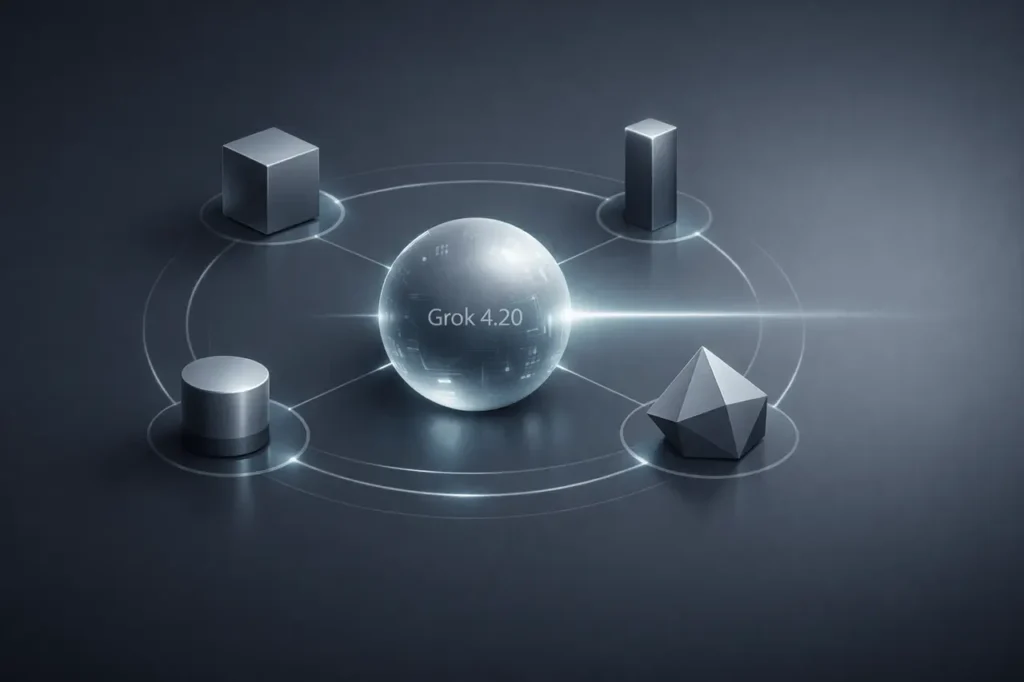
Grok 4.20 represents a brand-new direction in the field of advanced AI system design, based on multi-agent reasoning rather than single-stream generation. It is designed to handle complex analysis and forward-looking predictions. Grok 4.20 uses four specially designed AI agents to approach issues from different angles, discuss various conclusions, and ultimately arrive at a more precise final solution.
This internal debate system is designed to improve the accuracy and decrease errors in reasoning, thereby increasing predictive power. While numerous new AI models focus on parameter counts and scale, Grok 4.20 focuses on architectural intelligence by leveraging agent collaboration to simulate expert-level arguments before delivering results.
What Is Grok 4.20?
Grok 4.20 is a sophisticated AI model with a multi-agent architecture designed to enhance reasoning in forecasting, decision-making, and other tasks. In contrast to traditional single-model systems, Grok 4.20 uses four specialized agents to analyze issues from different angles and discuss internally before making a definitive decision.
This technology is designed to minimize hallucinations, enhance forecast accuracy, and provide more reliable outputs across areas such as forecasting, finance, and strategic evaluation.
The main innovation isn’t just about scale, but also structured internal debate and the process of building consensus.
How Grok 4.20’s Multi-Agent System Works?
The Four-Agent Framework
The core of Grok 4.20 is an AI system with multiple agents. Each agent:
- Solve the same issue independently
- Utilizes a unique reasoning technique
- Contests other agents’ beliefs
- Contributes to a final consensus decision
Instead of providing a single linear solution, Grok 4.20 organizes a well-structured discussion among the agents. This is similar to expert panel discussions, in which arguments from different sides are considered before a conclusion is reached.
Why Debate Improves AI Accuracy?
The traditional large-language models can generate responses in a single pass. Although powerful, this could:
- Early reasoning locks in mistakes
- Make use of incorrect assumptions
- Don’t miss other interpretations
In contrast, Grok 4.20’s agents:
- Propose competing hypotheses
- Critique weak reasoning
- Refine conclusions iteratively
The internal review of adversaries boosts the accuracy, particularly for prediction-intensive tasks.
Feature Comparison: Traditional Model vs Grok 4.20
This structural distinction explains why Grok 4.20 has been promoted as a better model for forward-looking analysis compared to other new frontier AI models.
Why Grok 4.20 Is Strong in Predictions?
A major and often debated feature in Grok 4.20 is its ability to forecast. Multi-agent systems are generally more effective in settings that:
- Many interpretations are possible.
- Uncertainty is extremely high.
- It is necessary to think strategically.
In tasks that require prediction, single models can be excessively confident. Grok 4.20’s internal deliberation mechanism helps reduce this risk by requiring:
- Scenario comparison
- Risk analysis
- Counter-argument evaluation
This method of reasoning is structured especially suited for areas like:
- Analysis of market trends
- Economic forecasting
- Strategic planning
- Complex problem solving
Although all AI predictions involve inherent uncertainties, structured multi-agent reasoning enhances their accuracy and rigor.
How Grok 4.20 Differs From Frontier AI Models?
Frontier AI models typically are based on:
- Massive training data
- Large parameter counts
- Reinforcement learning fine-tuning
Grok 4.20 shifts the focus to architecture intelligence and not just size.
Traditional Frontier Models
- The focus is on the size of the model in its raw form
- Produce highly fluid outputs
- Most often, it relies on single-chain reasoning
Grok 4.20’s Approach
- Multi-agent debate
- Perspective diversity
- Iterative consensus building
This design reflects ensemble learning techniques in machine learning, in which combining models increases each model’s accuracy.
Real-World Applications of Grok 4.20
1. Financial Analysis
Multi-agent systems are especially useful for financial forecasting, as they:
- Assess bearish and bullish scenarios
- Be aware of macro and micro variables
- Compare alternative outcomes
This reduces the risk of bias from single paths.
2. Strategic Decision-Making
Organizations that have to deal with complex trade-offs can benefit from:
- Argument simulation
- Risk modeling
- Multi-variable reasoning
Grok 4.20’s structure is perfectly compatible with the boardroom-style evaluation logic.
3. Research and Complex Problem Solving
For tasks that require advanced reasoning:
- Agents can simulate the test of hypotheses
- Counterfactuals can be analyzed
- Logical inconsistencies may be called into question
It is what makes Grok 4.20 appropriate for high-risk task analysis.
Advantages vs Limitations
No AI system is 100% reliable. Multi-agent reasoning enhances reliability, but doesn’t eliminate doubt.
Why Multi-Agent AI Represents a Shift in Model Design?
The wider AI landscape is changing beyond just scaling parameters.
Emerging trends include:
- AI agents collaborating
- Deliberate-based learning
- Ensemble reasoning systems
- Tool-augmented AI workflows
Grok 4.20 is a good example of this shift to thinking about innovation in architecture.
Instead of being able to ask “How big is the model?” The question becomes:
“How intelligently does the system reason?”
Practical Considerations for Businesses
Before using the Grok 4.20 or similar AI multi-agent systems, businesses should look at:
- Task complexity
- Need to ensure the reliability of predictive accuracy
- Computational cost tolerance
- Latency requirements
Multi-agent AI is particularly beneficial when:
- The stakes for decisions are high.
- Outcomes depend on scenario comparison
- Risk mitigation is critical
For basic tasks such as text summarization, the extra structure may not be required. Strategic forecasting could be a game-changer.
My Final Thoughts
Grok 4.20 is a major technological shift in AI development. By deploying four specially designed agents that discuss and converge on the correct answers, it shifts beyond single-stream reasoning to structured, consensus-driven intelligence.
The multi-agent system improves forecasting accuracy, enhances the quality of complex decision-making, and eliminates blind spots in reasoning. While it cannot eliminate uncertainty, it shows how collaborative AI agents can be superior to conventional techniques in high-risk analysis.
As AI continues to develop, architectural innovations, such as those seen in Grok 4.20, could be the defining factor in the next stage of intelligent systems, rather than just the size of models.
FAQs
1. What makes Grok 4.20 different from other AI models?
Grok 4.20 employs four specially designed AI agents that engage in internal debate before arriving at an answer. The multi-agent approach improves the reliability when compared to models that use a single stream.
2. Does Grok 4.20 help to eliminate AI hallucinations?
No AI model can eliminate hallucinations. But cross-agent critique reduces the likelihood of unchecked reasoning errors.
3. Why are multi-agent AIs better at predicting?
Predictions are based on analyzing various scenarios. Grok 4.20’s agents evaluate competing scenarios and then refine their conclusions with structured debates.
4. Is Grok 4.20 good for forecasting financials?
Its design is well-suited to complex forecasting tasks, as it considers risk, alternatives, and arguments before reaching conclusions.
5. Does multi-agent reasoning slow response times?
It could increase the computational cost compared with single-pass models, based on the implementation and the task’s complexity.
6. Is Grok 4.20 an ideal replacement for all of the frontier AI models?
Not necessarily. It’s a design style focused on structured reasoning, not just scaling. The ideal choice will depend on the specific use.
Also Read –