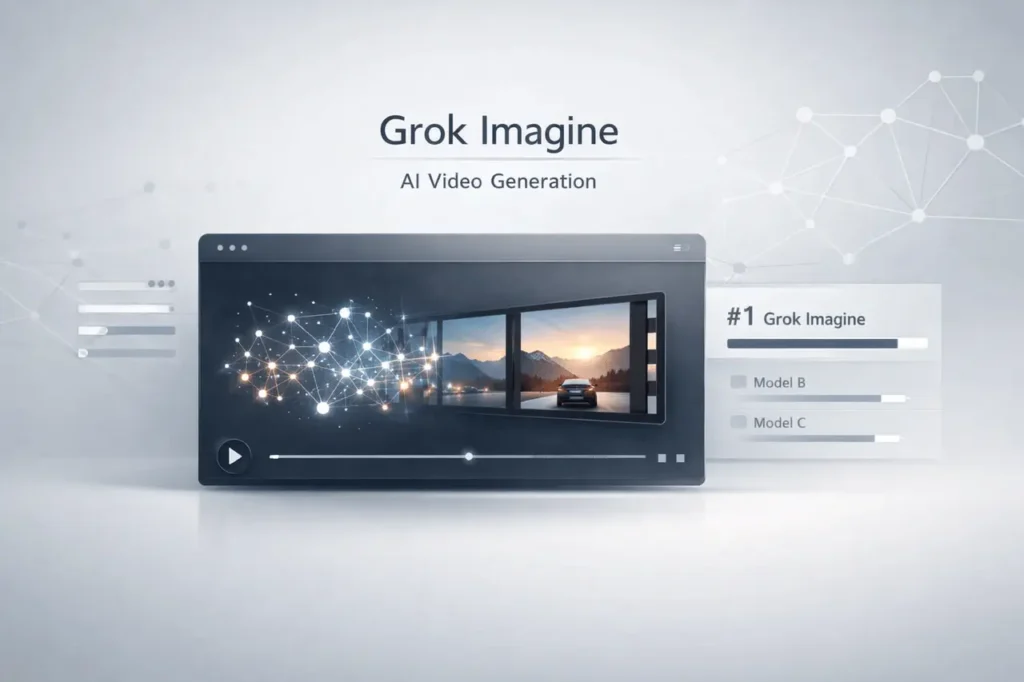
It’s xAI’s Grok Imagine has taken the highest spot in the Video Arena leaderboard, a test that evaluates the generative AI model for video, as per recently released results from a benchmark. The model is believed to have scored the top score on the leaderboard and beat out several variants from Google’s Veo video generation models and producing results much quicker.
The rankings suggest rapid advancement in AI the technology of video production and includes Grok Imagine getting the top Elo score on the leaderboard. It also shows the highest scores for user preferences and a lower latency for generation compared to other models.
Grok Imagine Achieves #1 Ranking on Video Arena
The benchmark results of the DesignArena Arcada Labs Video Arena demonstrate Grok Imagine reaching the top spot on the leaderboard despite an impressive performance gap.
Key benchmark highlights include:
- Elo score: 1336
- Win rate: 69.7%
- Total evaluation battles: 15,590
The results suggest the fact that Grok Imagine consistently performed better than other models when comparing pairwise that are used within the Video Arena evaluation framework.
In these tests, Grok Imagine reportedly surpassed various variants from Google’s Veo models that include:
- Veo 3 Fast
- Veo 3.1 Fast
- Veo 3.1
These results put Grok Imagine on top of the leaderboards with an advantage of over thirty Elo point in front of the model that is next in line and suggests that it has a statistically significant lead.
What the Video Arena Benchmark Measures?
The Video Arena leaderboard evaluates generative video models using a preference-based scoring system.
Models create videos based on the questions, and evaluaters compare the models with each other in “head-to-head “battles.” Every battle determines which model delivers the most convincing or exact outcome.
The system of ranking uses the Elo score model that is commonly employed in ranking systems for competitions like Chess.
Key metrics include:
| Metric | What It Measures |
|---|---|
| Elo Score | Overall ranking based on pairwise comparisons |
| Win Rate | Percentage of comparisons where the model was preferred |
| Battles | Total number of evaluated comparisons |
A large number of battles improves the statistical accuracy Grok Imagine’s analysis comprised greater than 15000 different comparisons that improves the credibility of the rankings.
Faster Generation Times Than Competing Models
Beyond the performance of ranking, generation speed is believed to be an additional benefit.
Based on information from the benchmark:
- Grok Imagine generation time: ~21.3 seconds
- Google Veo models: typically 40+ seconds
A lower latency is a crucial aspect for a variety of actual-world AI application in video, which includes:
- content creation workflows
- social media production tools
- marketing video generation
- interactive AI applications
The reduction in time to generate video is a significant improvement in accessibility for creators and developers who are integrating AI videos tools.
Why Grok Imagine’s Performance Matters?
The growth of Grok Imagine signals an important change within the AI video generation race that has grown rapidly in the last year.
A number of major tech companies are competing to develop top-quality text-to-video designs which include:
- Google using Veo
- OpenAI using Sora
- Runway using Gen-3
- Pika Labs featuring Pika Video models
Video generation has evolved into one of the more technically demanding areas in Artificial Intelligence because of the need to:
- temporal consistency across frames
- realistic motion physics
- high-resolution rendering
- accurate prompt interpretation
If the results of benchmarks are similar across different testing environments, the performance of Grok Imagine suggests that xAI has achieved significant progress in addressing certain of these issues.
Key Capabilities of Modern AI Video Models
Although the precise architectural specifications for Grok Imagine have not been publically disclosed, current video-to-text AI platforms generally combine different technologies.
These could comprise:
- diffusion-based video generation models
- large multimodal transformer architectures
- motion modeling networks
- temporal attention mechanisms
Together They allow models to create short video clips using natural prompts in the language.
Typical Capabilities
| Capability | Description |
|---|---|
| Text-to-video generation | Creates video from written prompts |
| Style and scene control | Allows prompt-based control of visuals |
| Motion consistency | Maintains realistic motion across frames |
| Multimodal understanding | Interprets language, context, and visual structure |
The capabilities are vital in applications ranging in scope from creation of media for creative purposes to the automated production and distribution of marketing material .
Growing Competition in AI Video Generation
The market for generative video is growing rapidly as companies compete to improve their speed, quality as well as accessibility.
Recent developments in the industry include:
- Google expands the access of Veo models
- OpenAI introduces Sora, a high-quality video generator
- Runway announces Gen-3 Alpha
- New startups building specialized video AI tools
Each model is focused on distinct goals, including:
- cinematic realism
- controllable motion generation
- production-ready video tools
Benchmarks such as that of the Video Arena leaderboard provide one method of comparing the performance, but real-world use typically depends on variables like edit control accessibility, cost, and so on.
What This Means for Developers and Creators?
In the event that Grok Imagine continues to maintain high benchmarking performance, it will be a key platform for developers creating intelligent tools for creativity. .
Potential use cases include:
- automatic video creation to promote marketing
- AI-driven content production pipelines
- game development prototyping
- educational visualization tools
- social media content creation
Speedier generation can also be appropriate to be used in Interactive AI-based application in which near-real-time or real-time generation is needed.
My Final Thoughts
The growth of Grok Imagine at the top of the Video Arena leaderboard demonstrates the growing competitiveness in the field of generative AI technological video. The fact that it has both a high Elo score and quicker time to generate suggests it is possible that xAI has made major advancements in the video synthesizing capabilities.
In the future, as AI technology for video continues to evolve performance benchmarks like Video Arena will be a crucial part of keeping track of progress among rival models. The wider trend indicates that the technology of text-to-video is rapidly shifting from experimental research to a practical infrastructure for creative creation, and companies are racing to develop speedier, more manageable and better-quality video generation technology.
FAQs
1. What is Grok Imagine?
Grok Imagine is an AI video generation model designed by xAI which converts text requests into videos through the generative AI strategies.
2. What exactly is this Video Arena leaders’ board?
Video Arena leaderboard Video Arena leaderboard serves as a test that assesses AI video models by using human preference comparisons as well as Elo-based ranking.
3. What was the score? How well did Grok Imagine fare in the Leaderboard?
Grok Imagine reached the top spot by achieving one Elo rating of 1336. a winning rate of 69.7 percent, and more than 15,000 battles in evaluation.
4. What is the difference between Grok Imagine compare with Google Veo?
Based on benchmarks, Grok Imagine outperformed several Veo models in head-to-head comparisons, and also produced videos more quickly.
5. Why is speed of generation important for AI videos?
Speedier generation decreases waiting times and enhances the user experience for developers, content creators and applications that require speedy production of video.
6. Do AI video generators readily accessible today?
A lot of AI video models are limited to research previews or limited platforms, but access is slowly expanding via APIs and other creative tools.
Also Read –