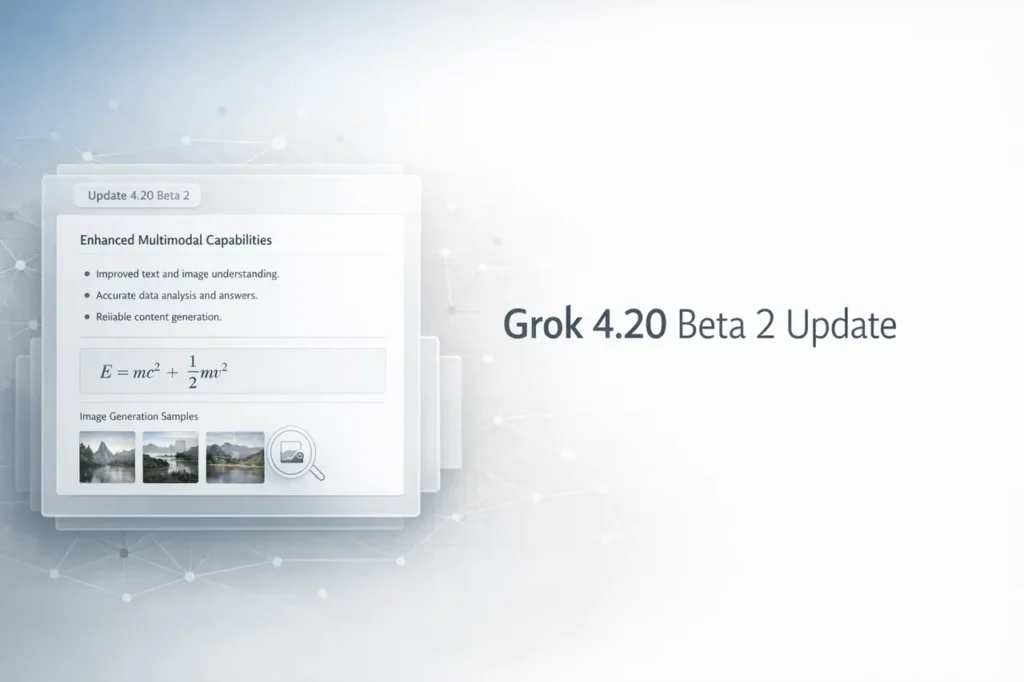
Grok 4.20 Beta 2 update provides tangible improvements in the following: instruction, hallucination reduction, scientific text formatting, image search accuracy, and multiple-image rendering stability.
Created by xAI and implemented in Grok, this release underscores the ongoing focus on model reliability and practical usability. These enhancements are crucial for developers, researchers, and enterprise users who require reliable outputs from large-scale model languages.
This article describes what changed, how it is relevant, and how the change affects the real-world AI processes.
What Is Grok 4.20 Beta 2?
Grok is an interactive AI model integrated into the X ecosystem. This Grok 4.20 Beta 2 update refines the model’s reasoning, output formatting, and multimodal behaviour.
This release is focused on five main areas:
- Better instruction following
- Capability hallucination reduction
- Quality LaTeX for scientific texts
- Specific image search activates
- Reliable multiple image rendering
These enhancements address the most common issues in AI use: inconsistent with the capabilities of fabricated systems, formatting issues, and unstable outputs for multimodal formats.
Instruction Following Improvements in Grok 4.20 Beta 2
Why Instruction Following Matters?
Instruction adherence is a determinant of whether an AI system can provide:
- Follow formatting constraints
- Respect word limits
- Maintain output structured
- Execute step-by-step requests
Inconsistent instructions often lead to incorrect or unaligned responses. For academic, technical, and business-related applications, it may lower confidence within the system.
What Improved in Beta 2?
The Grok 4.20 Beta 2 update enhances:
- Alignment with clear formatting rules
- Multi-step reasoning execution
- A reduced deviation from the constraints of the user
- Improved outputs that are structured (lists and headings, code blocks)
For enterprise AI use cases, such as documenting compliance or structured extraction, it reduces the effort required for post-processing and manual adjustment.
Capability Hallucination Reduction
Understanding AI Hallucinations
Capability hallucination can occur when a model states it is:
- Real-time data access even when it isn’t
- Retrieve private information
- Perform actions that are outside of the scope of its application
- Make use of tools that are not readily available
This is different from the hallucination of facts (inventing false facts). The hallucinations of capability can affect confidence and operational reliability.
Improvements in Grok 4.20 Beta 2
Update introduces more precise internal alignment mechanisms, which:
- Eliminate false claims about the capabilities of the system
- Enhance transparency regarding the limitations
- Avoid assertions that aren’t supported by the tool.
For companies that are looking to incorporate AI into workflows, it is essential. Overstating capabilities can lead to compliance issues and confusion.
Scientific Text Quality and High-Quality LaTeX Output
The most significant enhancement in Grok 4.20 Beta 2 is improved LaTeX rendering of mathematical and scientific text.
Why LaTeX Quality Is Important?
Researchers and engineers often count on:
- Mathematical notation
- Formulas with structures
- Heavy symbol-heavy formatting
- Publication-ready documentation
Poor LaTeX formatting can result in:
- Broken equations
- Misaligned symbols
- Invalid syntax
- Extended editing time
Improvements Introduced
Grok 4.20 Beta 2 enhances:
- Proper equation formatting
- Clearer, inline editor, and blocks for LaTeX
- Inconsistencies in syntax that are reduced
- Better rendering reliability
This model is more appropriate for:
- Academic research drafting
- STEM documentation
- Whitepapers on technical aspects
- Educational materials
Image Search Trigger Precision
The Problem With Ambiguous Triggers
A multimodal AI platform, imprecise or ambiguous image search triggers could:
- Retrieve irrelevant images
- Misinterpret context
- Over-trigger visual responses
This can affect the user experience, particularly in academic or analytical settings.
What’s New in Beta 2
The new version improves:
- Context-aware search for images activation
- Reducing false positive triggers
- More consistent alignment of the query and output
For content creators, analysts, and researchers, this means better visual augmentation of textual information.
Multiple Image Rendering Reliability
Multimodal AI systems often produce multiple images during a single interaction. But reliability issues can arise:
- Inconsistent rendering quality
- Missing outputs
- Partial responses
- Output order mismatches
Reliability Improvements
Grok 4.20 Beta 2 enhances:
- Stable multi-image generation
- Increased consistency of output
- Improved handling of concurrent image tasks
This is especially beneficial for:
- Visual content creation
- Educational material development
- Design prototyping
- Technical illustration workflows
Feature Comparison Table
Grok 4.20 Beta 2 vs Previous Iteration
| Feature Area | Before Beta 2 | Grok 4.20 Beta 2 |
|---|---|---|
| Instruction Following | Occasional format drift | Stronger constraint adherence |
| Capability Claims | Higher risk of overstatement | Reduced capability hallucination |
| LaTeX Output | Inconsistent formatting | Cleaner scientific notation |
| Image Search | Broader triggers | More precise activation |
| Multi-Image Rendering | Occasional instability | Improved reliability |
This contrast demonstrates the importance of quality rather than just expanding capabilities.
Real-World Applications
1. Academic and Research Workflows
- Better LaTeX support
- Written structure that is analytical
- Formatting corrections that are reduced
2. Enterprise AI Deployment
- Lower compliance risk
- More reliable outputs
- Better auditability
3. Content Creation
- Reliable multi-image generation
- Cleaner, structured articles
- Better technical formatting
4. Developer and Technical Use
- Clearer constraint handling
- Reducing capability overclaims
- Improved response to structured requests
Benefits and Practical Considerations
Key Benefits
- Greater output reliability
- Reduced hallucination risk
- Multimodal precision improved
- Support for enhanced scientific documentation
Limitations
- It is still a beta release
- Performance can vary based on the complexity of the prompt
- Multimodal systems are computationally demanding
Users must validate the results in high-risk contexts, especially in financial, legal, or medical situations.
Why the Grok 4.20 Beta 2 Update Matters?
Grok 4.20 Beta 2 update reflects a broader trend in AI development, moving away from flashy capabilities toward stable operation.
Instead of focusing on new features, this release is focused on:
- Trust
- Accuracy
- Constraint compliance
- Multimodal robustness
When organizations evaluate AI systems, the following characteristics are often more important than incremental gains in benchmarks.
My Final Thoughts
Grok 4.20 Beta 2 update is a significant improvement in AI reliability, not just the addition of new features. By enhancing instruction following, reducing the likelihood of hallucination, improving LaTeX formatting, and increasing multimodal accuracy, Grok moves closer to achieving enterprise-grade reliability.
As AI adoption increases across business, research, and content production, the stability of operations will define the long-term value. Grok 4.20 Beta 2 suggests that the next stage of AI development will prioritize transparency, trust, and controlled performance over hype-driven claims about capabilities.
FAQs
1. What is Grok 4.20 Beta 2?
Grok 4.20 Beta 2 is the latest version of the Grok AI model from xAI. It features improvements in instruction follow-up and hallucination reduction. LaTeX formatting and image rendering stability.
2. What is the best way to Grok 4.20 Beta 2 reduce hallucinations?
The upgrade reduces illusions by limiting false assertions about the system’s functions and by increasing the visibility of limitations in models.
3. Are you sure that Grok 4.20 Beta 2 is appropriate for writing scientific papers?
Yes. The latest version greatly enhances LaTeX output quality, which makes it more suitable for mathematical notation and structured documents for academics.
4. What are the triggers for image search enhancements?
The precision of the trigger for image searches ensures that visual outputs are activated only when appropriate to the context, reducing unwanted or undesirable outcomes.
5. Does this update help improve the multi-image generation?
Yes. Grok 4.20 Beta 2 enhances the reliability of rendering multiple images, providing stable outputs for multimodal tasks.
6. Are you sure that Grok 4.20 beta 2 is ready for production?
It’s labeled as a beta version. Although reliability has improved, businesses should continue testing outputs in critical areas.
Also Read –